DUQUESNE UNIVERSITY
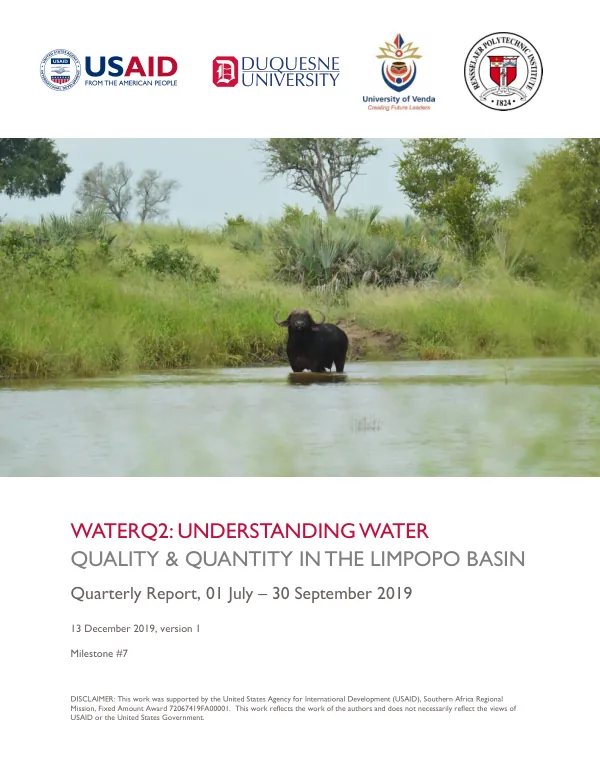
WaterQ2: Understanding Water Quality and Quantity in the Limpopo Basin
The Limpopo River Basin is a transboundary region spanning Botswana, Mozambique, South Africa, and Zimbabwe, covering an area of over 400,000 km2.
2019 · 38 pages
Sign in to readA free account is required to download.
Abstract
The Basin is home to 18 million people living in both rural and urban areas, with industries such as agriculture, mining, and urban businesses contributing to the region's economic growth. However, the Basin's water resources are under significant pressure due to the heterogeneous rainfall distribution, with some sub-basins receiving less than 400 mm annually and others receiving over 750 mm. The Basin has experienced severe droughts in the last decade, and the reliability of rainfall data and other water measurements is limited due to infrequent calibration and validation of field site measurements. To address these challenges, the project aims to build resilience through the support of Basin stakeholders, including The Limpopo Watercourse Commission (LIMCOM), to improve governance around water resources management and water security in the Basin. A systems approach, such as integrated water resources management (IWRM), is recommended to address the complex, large, and interrelated components of water resources. The project will support water resources monitoring, and the development of methods for water quality and quantity measurement based on in situ sensors and satellite measurements. These measurements will enable characterization of water resource dynamics at the whole Basin scale and form the foundation for hydrologic modeling that can help estimate hard-to-measure parameters and provide holistic assessments of Basin scale stocks and flows. To support data sharing, the project will use cloud-based, automated data collection and web-based data sharing. The project will also provide training, workshops, and conferences focused on integrated water resources management (IWRM) and environmental flow analysis. The results of the water resources and biodiversity studies conducted will be compiled into a report for the Basin stakeholders. The Limpopo Resilience Lab at the University of Venda will be established to support data collection efforts, training, and collaboration. The sustainability of lab activity will continue with the implementation of a small user fee beyond the duration of the project. In the second quarter of project year 2019-20, the collaborators, Duquesne University, Rensselaer Polytechnic Institute, and University of Venda, have made significant progress in the project. Master of Science candidate, Mr. Hilton Thivhonali Shimbabu, has submitted his thesis proposal to Univen after consultation with his research supervisors and project PIs, Drs. Edokpayi and Kahler. Univen has obtained a current meter and multiparameter water quality meter consistent with the items in the proposed budget. The hydrometeorological station network has been set up in key watersheds in the Limpopo Basin, with data available through the Development Data Library. The stations have been installed in the Mutale Weir, Mbehela School, Leshiba Wetland, and Medike Nature Reserve. Work continues on the use of satellites to measure river discharge, with Drs. Rose and Mlotha beginning work on measuring critical water quality parameters, specifically, turbidity and chlorophyll. The project has also made progress in supporting the work on national water laws and policies, and the human right to water in the Limpopo Basin. Duquesne has begun to catalog as many documents as possible in an online library collection, which is linked through the project website and available at dsc.duq.edu/limpopo. In the WaterQ2 Stakeholder Engagement meeting in August 2019 in Pretoria, participants expressed interest in the project's activities and progress.