DUQUESNE UNIVERSITY
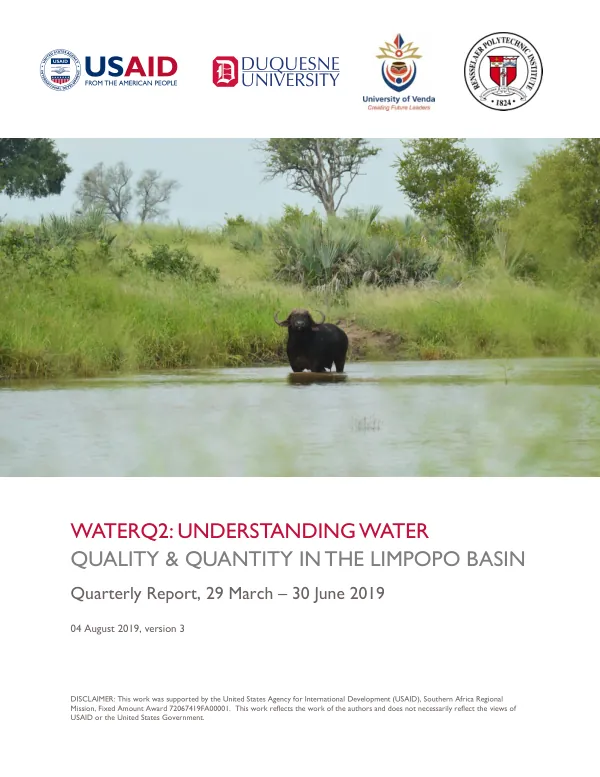
WaterQ2: Understanding Water Quality and Quantity in the Limpopo Basin
The Limpopo River Basin is a transboundary region spanning over 400,000 km2, encompassing Botswana, Mozambique, South Africa, and Zimbabwe.
2019 · 26 pages
Sign in to readA free account is required to download.
Abstract
The basin is home to 18 million people, with a diverse range of industries, including urban businesses, agriculture, and mining. The region is characterized by heterogeneous rainfall patterns, with some sub-basins receiving less than 400 mm annually and others receiving over 750 mm. Severe droughts have affected the basin in the last decade, and the reliability of rainfall data and other water measurements is limited due to infrequent calibration and validation of field site measurements. The project, WaterQ2: Understanding Water Quality and Quantity in the Limpopo Basin, aims to build resilience through the support of basin stakeholders, including The Limpopo Watercourse Commission (LIMCOM), to improve governance around water resources management and water security in the basin. A systems approach, such as integrated water resources management (IWRM), is necessary to address the complex, large, and interrelated components of water resources. The project will support water resources monitoring, the development of methods for water quality and quantity measurement, and the establishment of a cloud-based, automated data collection and web-based data sharing system. The project will also provide training, workshops, and conferences on integrated water resources management (IWRM) and environmental flow analysis. Local capacity to maintain water resources and make proactive, scientifically justified management decisions will be developed through the project. The Limpopo Resilience Lab at the University of Venda will be established to support data collection efforts, training, and collaboration. Annual training workshops and conferences will be located at or nearby the Resilience Lab. Personnel management and training are critical components of the project. Dr. McArd Joseph Mlotha, a postdoctoral research associate, has been appointed to develop curriculum on remote sensing, GIS, and water quality research and education. Duquesne University MS-candidate, Mackenzie Martin, has selected her thesis committee. Two graduate students, Mr. Ntwanano Mutileni and Mr. Hilton Thivhonali Shimbabu, have been awarded assistantships through the project. Responsible conduct of research is a priority for the project. All key personnel and students will complete university-coordinated responsible conduct of research (RCR) programs. Branded labels have been produced and will be affixed to all instruments and non-consumable supplies purchased through the grant. Satellite algorithms will be developed to support water monitoring. Through Planet Labs, Inc., staff has acquired satellite images from known stations along the Mutale River. Duquesne has begun to catalog national water laws and policies, and the human right to water in the Limpopo Basin, in an online library collection. The online library will be included in the website rollout scheduled for August 2019.