USAID DEC
West Africa Regional Technical Meeting on Adolescent and Youth Sexual and Reproductive Health
Sign inPATHFINDER INTERNATIONAL
West Africa Regional Technical Meeting on Adolescent and Youth Sexual and Reproductive Health
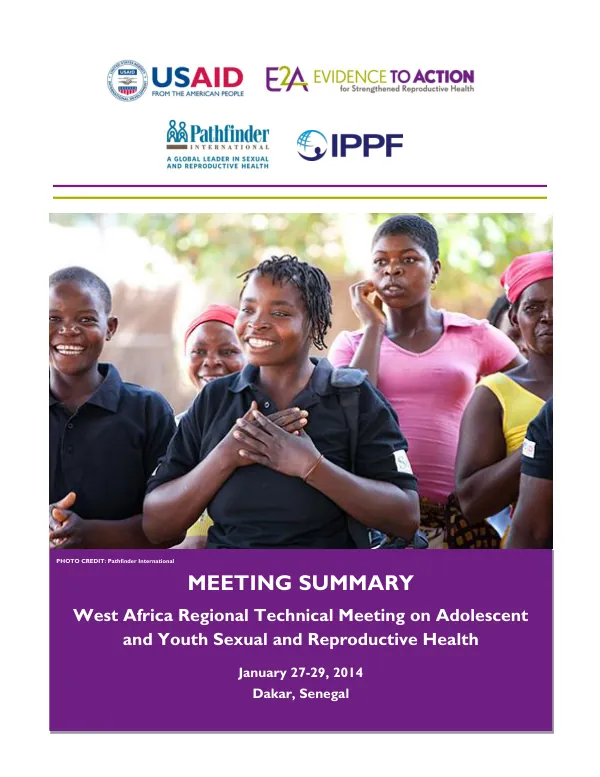
The West Africa Regional Technical Meeting on Adolescent and Youth Sexual and Reproductive Health was held in Dakar, Senegal, from January 27-29, 2014.
2014 · 16 pages
Sign in to readA free account is required to download.
Abstract
The meeting was organized by the USAID-funded Evidence to Action for Strengthened Family Planning and Reproductive Health Services for Women and Girls Project, in collaboration with Pathfinder International and the International Planned Parenthood Federation. The meeting aimed to enhance governments' commitments to improving young people's sexual and reproductive health in Francophone West Africa. The meeting brought together representatives from nine countries, including Benin, Burkina Faso, Côte D'Ivoire, Guinea, Mali, Mauritania, Niger, Senegal, and Togo. Participants included ministries of health, representatives from IPPF affiliates, staff from the E2A Project and Pathfinder International, and partners and donors, including USAID, the West African Health Organization, the United Nations Population Fund, and the World Health Organization. The meeting focused on state-of-the-art practices in adolescent and youth sexual and reproductive health (AYSRH) that the nine countries may choose to introduce or scale up. Presentations and panel discussions covered topics such as AYSRH policies and programs, systematic approaches to introduce and scale up best practices, new evidence related to AYSRH, and best practices to improve AYSRH. Youth as Seen by Youth Marketplace was an interactive session where young people from NGOs and youth associations in Senegal reported data collected from their peers concerning their thoughts about AYSRH and rights. The data highlighted several challenges, including a lack of information for out-of-school youth, inadequate information addressing young people's needs, disrespectful and judgmental attitudes of providers, and sociocultural barriers. The nine participating countries identified challenges relevant to implementing AYSRH policies and programs in their countries, priorities on which the countries are focusing, and progress towards implementing the Ouagadougou action plans. Some challenges included the high prevalence of sexually transmitted infections and HIV, early marriage and pregnancy, the lack of sexual and reproductive health information and services offered to young people, and the poor quality of AYSRH services. Country representatives spoke of the need for support to refine action plans, speeding up their implementation, closing funding gaps, fostering better coordination of stakeholders at the country level, as well as the need to monitor progress and financial commitments. With regard to AYSRH, country representatives presented ongoing work related to AYSRH, most of which was still implemented on a small scale, and with weak documentation. Alexis Ntabona from ExpandNet and Suzanne Reier from Implementing Best Practices Initiative presented the ExpandNet approach, which includes nine steps for developing a scaling up strategy. The presenters also offered 12 recommendations that can be applied to encourage the development of pilot projects focused on the long-term goal of scale-up, including ensuring the relevance of the intervention, engaging in a participatory process involving key stakeholders, and planning for documentation, evaluation, and diffusion of learning. The meeting fostered knowledge, collaboration, and a commitment among governments to prioritizing and improving young people's sexual and reproductive health across West Africa. At the close of the meeting, representatives from each of the nine countries met with partners and donor staff to create roadmaps for accelerating youth programming within the scope of the action plans developed at the 2011 Ouagadougou family planning meeting.