USAID DEC
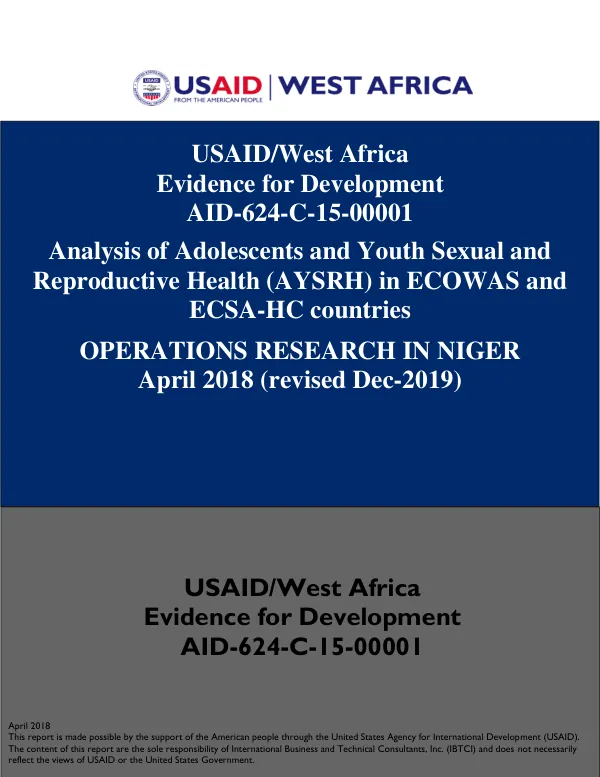
Analysis of Adolescents and Youth Sexual and Reproductive Health (AYSRH) in ECOWAS and ECSA-HC countries
Sign inINTERNATIONAL BUSINESS AND TECHNICAL CONSULTANTS, INC.
Analysis of Adolescents and Youth Sexual and Reproductive Health (AYSRH) in ECOWAS and ECSA-HC countries
Adolescents and Youth Sexual and Reproductive Health (AYSRH) in ECOWAS and ECSA-HC countries is a critical area of focus for development initiatives.
2018 · 87 pages
Sign in to readA free account is required to download.
Abstract
The region's high population growth rate, coupled with limited access to education and economic opportunities, exacerbates the challenges faced by adolescents and youth in achieving their reproductive health goals. Theoretical frameworks, such as cultural inheritance theory, social disorganization and human capital model, rational adaptation theory and financial capital model, and health behavior and risk behavior models, provide a foundation for understanding the complex factors influencing AYSRH outcomes. Interventions targeting social and cultural barriers, as well as socioeconomic vulnerabilities, have been implemented to address these challenges. A study conducted in ECOWAS and ECSA-HC countries analyzed data from a sample of adolescents and youth to examine trends in AYSRH outcomes. The study population was characterized by a high percentage of young people with limited access to education and economic opportunities. In ECOWAS countries, the majority of the study population was female, with a higher percentage of young women with secondary education or above compared to young men. The study found significant trends in AYSRH outcomes, including a decline in the percentage of adolescents 15-19 who report having ever had sexual intercourse, and a decrease in the percentage of young women with unmet need for family planning. However, the prevalence of modern contraceptive use among female youth remained low, and condom use during the last sexual intercourse among young people was also low. The study also identified factors associated with early initiation to sexual intercourse among female and male adolescents, including socioeconomic categories and access to education. Profiling of female and male adolescents more exposed to early sexual intercourse revealed that those from lower socioeconomic backgrounds and with limited access to education were at higher risk. The study's findings have implications for the development of targeted interventions aimed at improving AYSRH outcomes in ECOWAS and ECSA-HC countries. Addressing the complex factors influencing AYSRH outcomes, including social and cultural barriers, socioeconomic vulnerabilities, and access to education and economic opportunities, is critical to achieving the region's reproductive health goals. The study's results highlight the need for a comprehensive approach to addressing AYSRH challenges, including the development of targeted interventions, the strengthening of health systems, and the promotion of education and economic opportunities for adolescents and youth. By addressing these challenges, the region can work towards achieving the Sustainable Development Goals (SDGs) related to reproductive health and well-being. The study's methodology involved the analysis of data from a sample of adolescents and youth in ECOWAS and ECSA-HC countries. The study population was characterized by a high percentage of young people with limited access to education and economic opportunities. The study found significant trends in AYSRH outcomes, including a decline in the percentage of adolescents 15-19 who report having ever had sexual intercourse, and a decrease in the percentage of young women with unmet need for family planning.