USAID DEC
What role can information play in improved equity in Pakistan’s irrigation system? Evidence from an experimental game in Punjab
Sign inINTERNATIONAL FOOD AND POLICY RESEARCH INSTITUTE
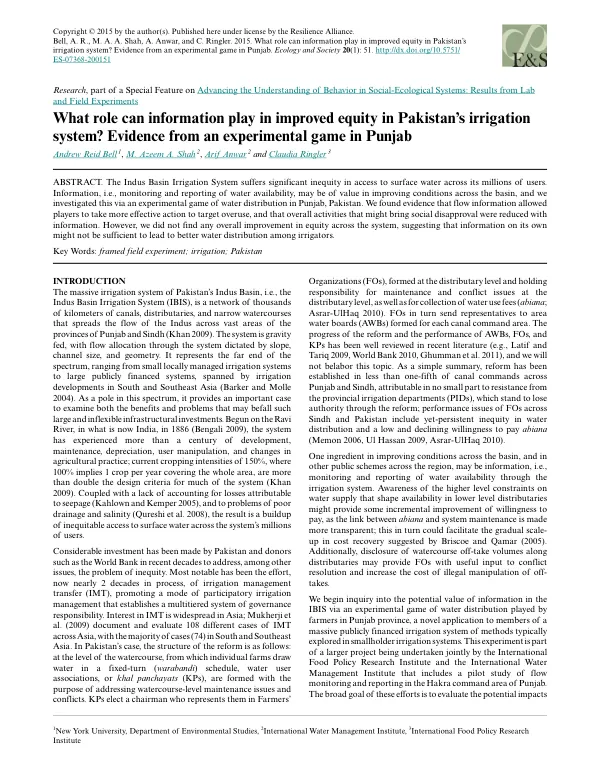
What role can information play in improved equity in Pakistan’s irrigation system? Evidence from an experimental game in Punjab
The Indus Basin Irrigation System (IBIS) in Pakistan suffers from inequity in access to surface water across its millions of users.
2015 · 23 pages
Sign in to readA free account is required to download.
Abstract
The system is a massive network of canals, distributaries, and narrow waterways that spreads the flow of the Indus across vast areas of the provinces of Punjab and Sindh. The system is gravity-fed, with flow allocation dictated by slope, channel size, and geometry. It is one of the largest publicly financed systems in South and Southeast Asia, with a history dating back to 1886. The system has experienced more than a century of development, maintenance, depreciation, user manipulation, and changes in agricultural practice. Current cropping intensities of 150% are more than double the design criteria for much of the system. A lack of accounting for seepage and problems of poor drainage and salinity has led to a buildup of inequitable access to surface water across the system's millions of users. Despite significant investment by the government and donors such as the World Bank, inequity persists. The structure of the irrigation management transfer (IMT) reform in Pakistan involves the formation of water user associations, or khal panchayats (KPs), at the watercourse level. These associations address watercourse-level maintenance and conflicts, and elect a chairman who represents them in Farmers' Organizations (FOs). FOs are responsible for distributary-level maintenance and conflict issues, as well as collection of water use fees (abiana). However, the reform has been established in less than one-fifth of the country, and performance issues include yet-persistent inequity in water distribution and a low and declining willingness to pay abiana. One potential solution to improving conditions across the basin is the use of information, or monitoring and reporting of water availability through the irrigation system. Awareness of the higher-level constraints on water supply that shape availability in lower-level distributaries may lead to incremental improvement of willingness to pay, as the link between abiana and system performance is made more transparent. Disclosure of watercourse off-take volumes may also provide FOs with useful information for conflict resolution and increase the cost of illegal manipulation of off-takes. To evaluate the potential contribution of flow information to improving water outcomes, an experimental game was played by farmers in Punjab province. The game was part of a larger project that aims to evaluate the impacts of information on farmer behavior and system-level efficiency and equity outcomes. The role of information in shared water resources is well-studied, with research highlighting its importance in resolving information asymmetries and establishing rules and norms for sustainable collective action. In the context of the IBIS, information remains important despite the scale of the system. Farmers at the heads of distributaries or watercourses have better water supply information, which may contribute to inequity. The current study aims to understand the potential contribution of flow information alone to improving equity and efficiency outcomes in the IBIS. The use of flow gauges is not common in Pakistan, and where present, they may be degraded beyond use. The study hopes to provide an understanding of the possible tools for improving performance in large public irrigation systems. Experimental games have been used in irrigation systems to evaluate the impact of information on farmer behavior and system-level outcomes. A previous study developed a paper-based game for small, self-governed irrigation systems, which found a preference for equity over punishment in water distribution. Another study used a computer-based game with five players, combining a public-goods game with upstream-downstream water distribution. The study found that players chose a resource contribution based on the level of water scarcity.