USAID DEC
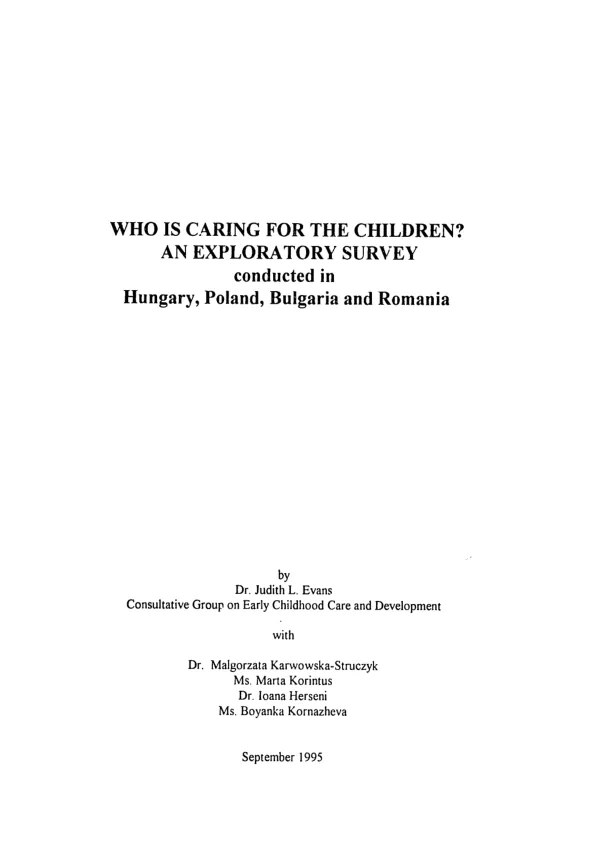
Who is caring for the children? : an exploratory survey conducted in Hungary, Poland, Bulgaria and Romania
Sign inCONSULTATIVE GROUP ON EARLY CHILDHOOD CARE AND DEVELOPMENT
Who is caring for the children? : an exploratory survey conducted in Hungary, Poland, Bulgaria and Romania
The effects of economic reform on child care in Poland, Hungary, Romania, and Bulgaria are examined.
Evans, Judith L.; Karwowska-Struczyk, Malgorzata · 1995
Sign in to readA free account is required to download.
Abstract
The study, which covers an 18-month period during 1994-1995, compiled data on young children, characteristics of the mother, birth outcomes, the impact of the transition on the family, child care, children"s homes, and changes in benefits. While variations exist among countries, general conclusions were as follows. (1) The majority of children 0-3 years of age are still being cared for within the family -- whether or not women are on paid leave, on unpaid leave, or unemployed. (2) The percentage of children aged 3-6 years that are attending preschool/kindergarten has not changed dramatically since the reforms, but is on the decline. In Poland more children are seeking places than there are places available, but in the other countries the existing places are not full, although the distribution of places does not always match children"s needs. (3) Parents would like their children to attend preschool/kindergarten, but current fees are prohibitive. There are no clear data on how parents are providing for children who no longer attend these programs. In some instances there is much greater reliance on the extended family; in others, there are informal care networks within neighborhoods. (4) Introducing or increasing fees will increase inequities in access to early childhood programs and thereby the inequalities in children"s primary school performance: children who have had early childhood experiences will advance, those who have not will fall behind. (5) The quality of care within center-based programs is declining. Resources are no longer available to maintain the necessary professional staff, and the maintenance of facilities largely depends on the commitment of local authorities to the provision of child care. Includes bibliography.
Related documents