WORLD HEALTH ORGANIZATION
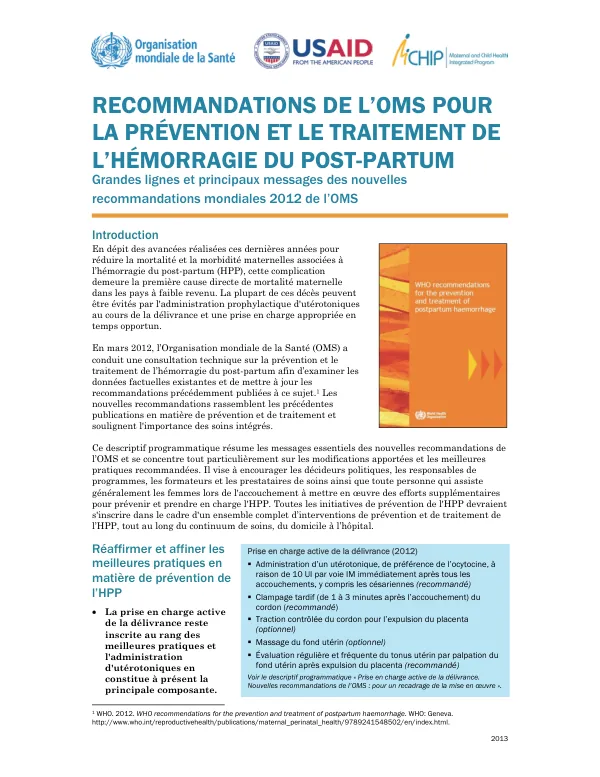
WHO Recommendations for the Prevention and Treatment of Postpartum Hemorrhage
The World Health Organization (WHO) has issued new recommendations for the prevention and treatment of postpartum hemorrhage (PPH).
2012 · 5 pages
Sign in to readA free account is required to download.
Abstract
PPH remains the leading direct cause of maternal mortality in low-income countries, accounting for the majority of deaths that can be prevented by administering prophylactic uterotonic agents during delivery and timely appropriate care. The WHO conducted a technical consultation in March 2012 to examine existing data and update previous recommendations on PPH prevention and treatment. The new recommendations emphasize the importance of integrated care and combine previous publications on prevention and treatment. They aim to encourage policymakers, program managers, trainers, and healthcare providers to implement additional efforts to prevent and manage PPH. The active management of the third stage of labor (AMTSL) remains a key component of PPH prevention. The administration of a uterotonic agent, preferably oxytocin, is now the primary component of AMTSL. Oxytocin is the uterotonic agent of choice for AMTSL, with a dose of 10 IU administered intramuscularly immediately after delivery. If oxytocin is not available, it can be replaced by ergometrine or misoprostol. The other components of AMTSL, including controlled cord traction and immediate uterine massage, are optional in PPH prevention. Recent data have shown that these practices have very few additional beneficial effects in preventing PPH. However, if no skilled birth attendant is present and oxytocin is not available, non-medical personnel or community health workers should administer 600 mcg of misoprostol orally to prevent PPH. The WHO recommends that all women receive a uterotonic agent during delivery to prevent PPH. The administration of a uterotonic agent has been shown to be effective in reducing the duration of delivery and the risk of PPH. If oxytocin is not available, it can be replaced by ergometrine or misoprostol. The clampage tardif du cordon ombilical (clampage of the umbilical cord one to three minutes after delivery) is recommended for all births, simultaneously with the initiation of essential newborn care, to reduce the risk of anemia in the newborn. Early cord clamping (less than one minute after birth) should only be performed if the newborn is asphyxiated and needs to be immediately resuscitated. In settings where skilled birth attendants are available, controlled cord traction is recommended for vaginal births if the healthcare provider and the woman consider a slight reduction in blood loss and delivery time to be important. In settings without skilled birth attendants, controlled cord traction is not recommended. The WHO recommends that policymakers and program managers ensure the availability of oxytocin and its proper storage in all healthcare facilities where births occur. They should also monitor stock ruptures and evaluate the quality of oxytocin in case of doubt about the cold chain and medication storage. The active management of the third stage of labor should be continued in national policies and in all maternity facilities by all categories of healthcare providers with midwifery skills. The WHO also recommends that the administration of a uterotonic agent be included in all programs of initial and continuing education for skilled birth attendants. They should ensure the existence of surveillance and follow-up systems for the implementation of active management of the third stage of labor. The indicator of coverage of prophylactic uterotonic administration should be included as a procedure indicator for national programs.
Related documents