PENNSYLVANIA STATE UNIVERSITY
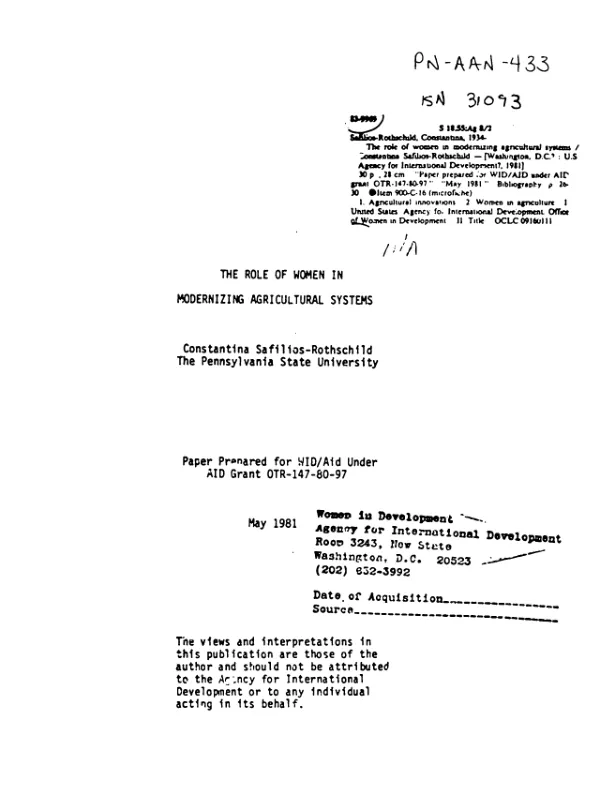
Role of women in modernizing agricultural systems
Although masked by class and sex biases and the scarcity of household labor and income data, available evidence, summarized in this report, indicates that women play a critical role in modernizing developing country agricultural systems.
Safilios-Rothschild, Constantina · 1981
Sign in to readA free account is required to download.
Abstract
A review of pertinent evidence from countries in A.I.D."s major geographical regions reveals that women, in addition to their household and childcare tasks, play an active and varied role in agriculture, e.g., as producers (generally in independent small holdings), farm managers, unpaid family workers, and - especially in countries where the percentage of landless households is increasing - as agricultural wage laborers whose work is essential to household survival. On the basis of this evidence, a typology is proposed for designing agricultural projects affording men and women equal opportunity for productivity and income, and strategies are discussed to address the key rural development indicators comprising the typology - labor and land scarcity and supply, the percentage of female-headed households, and the availability to both men and women of off-farm employment. The role of women"s cooperatives and associations is stressed. The study notes in conclusion that greater inclusion of women in developing country agricultural projects is needed to increase productivity and household income and food availability, diminish sex and class inequalities, and reduce female rural-to-urban migration.
Connected topics