INTERNATIONAL CENTER FOR RESEARCH ON WOMEN (ICRW)
WOMEN - HEADED HOUSEHOLDS; THE IGNORED FACTOR IN DEVELOPMENT PLANNING
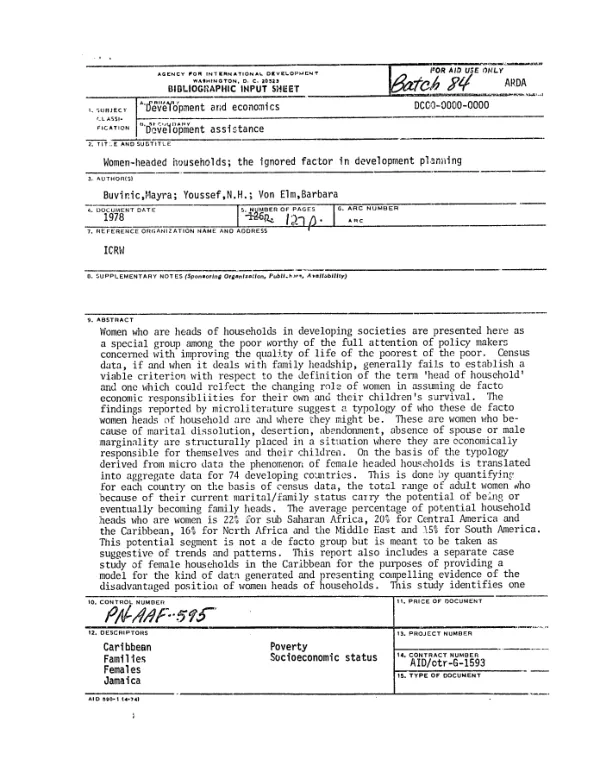
Women who are heads of households in developing societies are presented here as a special group among the poor worthy of the full attention of policy makers concerned with improving the quality of life of the poorest of the poor.
BUVINIC, MAYRA; YOUSSEF, NADIA H. +1 more · 1970
Sign in to readA free account is required to download.
Abstract
Census data, if and when it deals with family headship, generally fails to establish a viable criterion with respect to the definition of the term "head of household" and one which could reflect the changing role of women in assuming de facto economic responsibilities for their own and their children"s survival. The findings reported by microliterature suggest a typology of who these de facto women heads of household are and where they might be. These are women who, because of marital dissolution, desertion, abandonment, absence of spouse or male marginality, are structurally placed in a situation where they are economically responsible for themselves and their children. On the basis of the typology derived from micro data the phenomenon of female headed households is translated into aggregate data for 74 developing countries. This is done by quantifying for each country on the basis of census data, the total range of adult women who because of their current marital/family status carry the potential of being or eventually becoming family heads. The average percentage of potential household heads who are women is 22% for sub-Saharan Africa, 20% for Central America and the Caribbean, 16% for North Africa and the Middle East and 15% for South America. This potential segment is not a de facto group but is meant to be taken as suggestive of trends and patterns. This report also includes a separate case model for the kind of data generated and presenting compelling evidence of the disadvantaged position of women heads of households. This study identifies one group of people who are among the poorest of the poor and suggests that policies geared to assist these women would be a significant weapon in the struggle against poverty.
Related documents