INTERNATIONAL CENTER FOR RESEARCH ON WOMEN (ICRW)
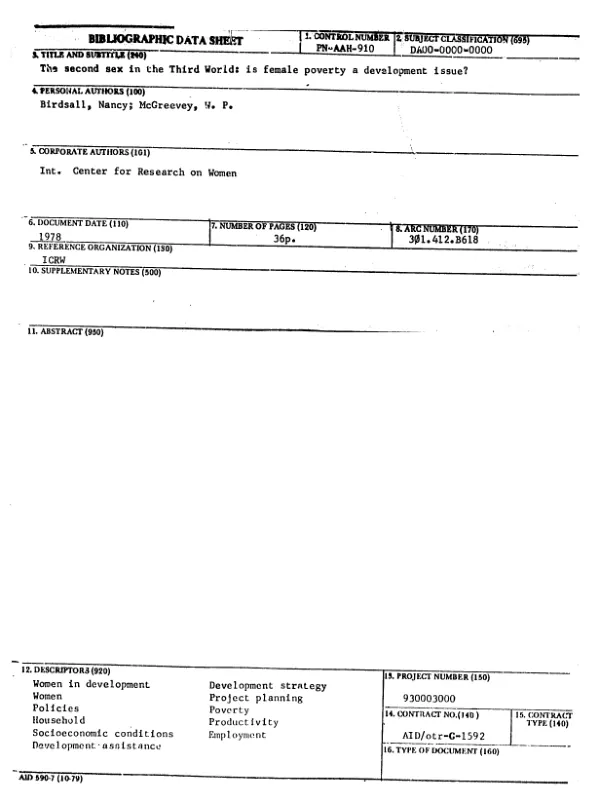
SECOND SEX IN THIRD WORLD : IS FEMALE POVERTY A DEVELOPMENT ISSUE?
Most development assistance is directed toward the poor but largely ignores the status and needs of women who may be the poorest of the poor.
BIRDSALL, NANCY; McGreevey, William Paul · 1970
Sign in to readA free account is required to download.
Abstract
Little is known, however, about the participation of poor women in socioeconomic development or the hidden value of their household contributions. This report summarizes proceedings of an AID-sponsored workshop conducted by the International Center for Research on Women in Elkridge, Maryland, April 30-May 2, 1978. The report focuses on women"s productivity in the household and in the marketplace; the relationship between women"s productive ability in the household and household welfare; production and consumption patterns of households headed by women; and the adequacy of current socioeconomic indicators to grasp work patterns and wants of poor women. Previous employment surveys barely implied the economic contribution women make to the real income and well-being of the poor, whereas surveys of market/home time budgeting accurately portray its magnitude. To measure this contribution, full (as opposed to market) income should be evaluated. Full income is a woman"s total contribution of child care, food preparation, and other home production activities to a household, expressed as services meriting monetary payment. The development of women"s market productivity is limited by their nearly total responsibility for child care and menial home duties, forcing them to choose low paying work in the economy"s informal sector to maintain schedule flexibility. Many daughters quit school to assist their mothers, limiting their own future access to formal employment and perpetuating the cycle of underdevelopment. Female-headed households are likely to be poorer than those headed by a male. In one study, 41% of female-headed households had incomes graded as too low to satisfy most basic needs, while only 27% of male-headed households received the same assessment. This report recommends the implementation of development projects specifically addressing the needs of women among the poor, as opposed to trickle-down efforts to assist females by improving the condition of males. Appended are 27 footnotes and a list of the 18 papers submitted at the workshop.