USAID DEC
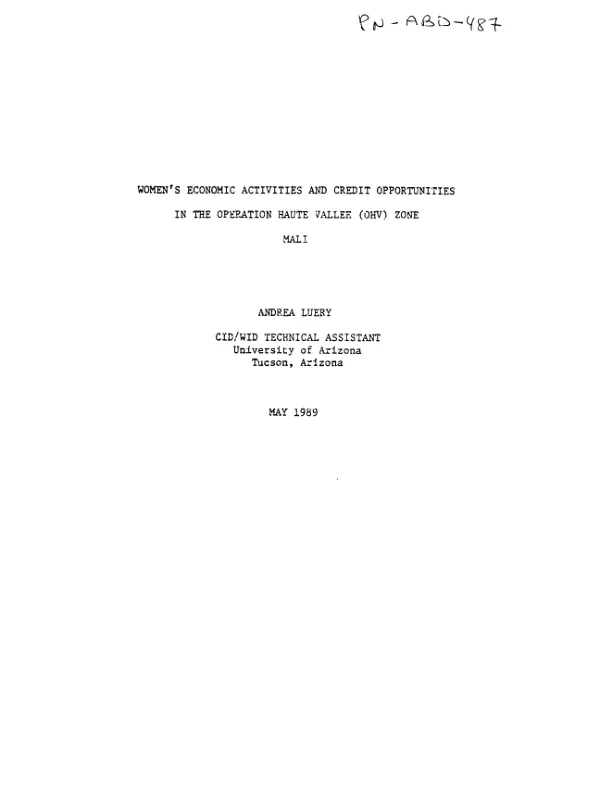
Women"s economic activities and credit opportunities in the operation Haute Vallee (OHV) zone, Mali
Sign inSOUTH-EAST CONSORTIUM FOR INTERNATIONAL DEVELOPMENT (SECID). CENTER FOR WOMEN IN DEVELOPMENT
Women"s economic activities and credit opportunities in the operation Haute Vallee (OHV) zone, Mali
West Africa"s formal financial institutions have proved ineffective for farmers - particularly women, who make up nearly half of the agricultural labor force.
Luery, Andrea · 1989
Sign in to readA free account is required to download.
Abstract
This report focuses on the economic resources available to a sample of 56 Malian women from four villages in the southern zone of the Niger River"s upper valley. The report describes the women"s credit and economic activities and summarizes their perceptions of these activities and their obstacles to obtaining credit. Research findings are then presented in detail, including a net-benefit account of 16 economic enterprises, and a listing of capital requirements for and costs of undertaking income-generating activities. Women in the sample identified their most beneficial economic activities as farming (41%), shea nut production (25%), and commerce (30%). When asked what would facilitate and increase the potential of their work, 59% cited farm equipment, particularly oxen and plow (42%), while 34% chose grinding mills and shea nut presses. In the absence of formal credit opportunities, women have formed local informal savings and loans associations known as tontines. It is recommended that efforts to improve women"s access to capital focus on strengthening such indigenous infrastructures.
Connected topics
Related documents
![Mali seed sector development plan : initiative to end hunger in Africa [IEHA] -- agricultural policy development program](https://covers.devme.ai/gen/35928.webp)