ABT ASSOCIATES
Workshop Report: Regional Trade Rules for the Dakar–Bamako Corridor
Regional Trade Rules for the Dakar–Bamako Corridor The Dakar–Bamako Corridor is a key trade route in West Africa, connecting Senegal and Mali.
2012 · 15 pages
Sign in to readA free account is required to download.
Abstract
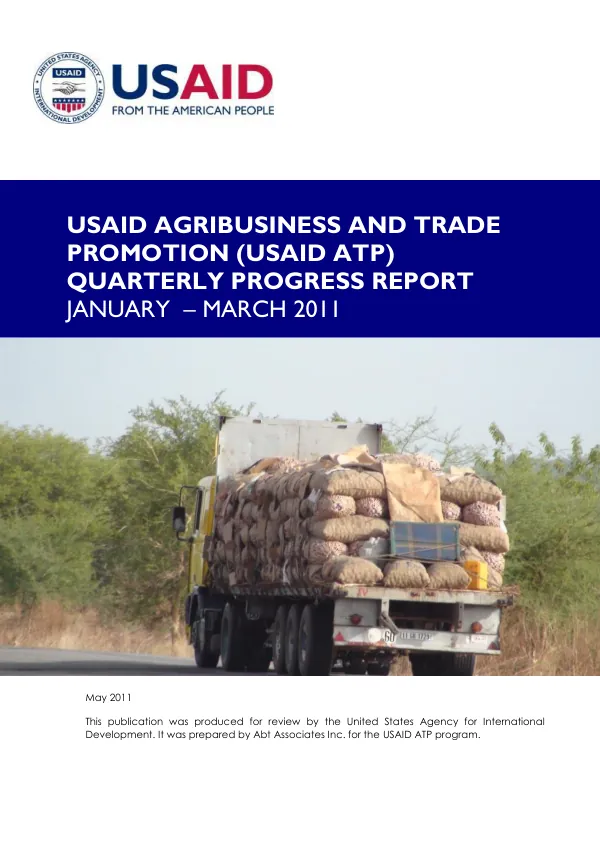
The corridor faces challenges related to trade and transport, including road harassment being a major obstacle. To address these issues, the Agribusiness and Trade Promotion (ATP) project, in collaboration with the Expanded Agribusiness and Trade Promotion (E-ATP) project, conducted a workshop on regional trade rules for the Dakar–Bamako Corridor. The workshop, held on June 8, 2010, at the Hotel Terrou Bi in Dakar, was organized by the bilateral USAID project Projet de Croissance Economique (PCE). The training covered the documentation required for the driver, the vehicle, and the goods for the six ATP/E-ATP value chains. The workshop highlighted the issues faced by traders, including the need for redress available to individual operators and value chain associations. Approximately 60 people attended the workshop, including six female officials. The ATP project has collaborated with other bilateral USAID-funded projects to leverage regional and national perspectives and efforts. One such collaboration was with the PCE project in Senegal to address problems at the Senegal-Mali border. As part of efforts to study trade policy barriers related to agricultural products and reduce these barriers, ATP's trade policy team met with Heads of Service, officials of ministries of agriculture, trade, and transit, and members of the National and Transit Facilitations Committees in Ghana, Mali, and Senegal. ATP also collaborated with the West Africa Trade (WATH) project and the Projet de Croissance Economique (PCE) project. The workshop aimed to reduce trade barriers and improve the flow of goods and services along the Dakar–Bamako Corridor. The interaction between ATP and PCE resulted in a resolution to support the border conference and trade promotion projects, which were viewed as pragmatic solutions to enhance regional integration and improve the free movement of goods and services. The border conference, scheduled for October 2010, aimed to improve the conditions for trade and transport along the Dakar–Bamako Corridor. The workshop highlighted the need for a customs union in the context of the ECOWAS and UEMOA agreements. ATP's policy team presented on the objectives, strategies, and strategies of the ATP/E-ATP project, as well as the ECOWAS liberalization scheme and the constraints to intra-regional trade in agricultural products. The workshop also discussed strategies for improving regional trade and reducing trade barriers. The workshop resulted in a strong resolve to support the border conference and trade promotion projects. The conference, scheduled for October 2010, aimed to improve the conditions for trade and transport along the Dakar–Bamako Corridor. The interaction between ATP and PCE resulted in a commitment to find lasting solutions to the trade and transport challenges faced by the corridor. The workshop highlighted the need for a customs union in the context of the ECOWAS and UEMOA agreements.