BANK FOR WEST AFRICAN DEVELOPMENT
World Water Week Daily
The importance of building partnerships and aligning agendas was a core theme at World Water Week 2013.
2013 · 4 pages
Sign in to readA free account is required to download.
Abstract
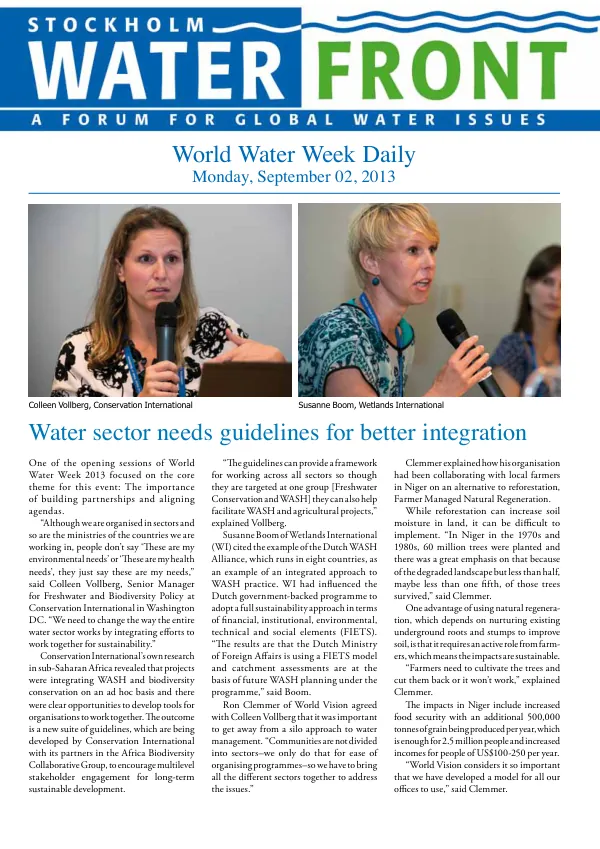
Colleen Vollberg, Senior Manager for Freshwater and Biodiversity Policy at Conservation International, emphasized the need to change the way the water sector works by integrating efforts to work together for sustainability. Conservation International's research in sub-Saharan Africa revealed that projects were integrating WASH and biodiversity conservation on an ad hoc basis, with clear opportunities to develop tools for organisations to work together. As a result, a new suite of guidelines is being developed by Conservation International with its partners in the Africa Biodiversity Collaborative Group to encourage multilevel stakeholder engagement for long-term sustainable development. Farmer Managed Natural Regeneration, an alternative to reforestation, was presented as a successful approach in Niger. This method involves nurturing existing underground roots and stumps to improve soil, requiring an active role from farmers, which means the impacts are sustainable. The impacts in Niger include increased food security with an additional 500,000 tonnes of grain being produced per year, which is enough for 2.5 million people, and increased incomes for people of US$100-250 per year. World Vision considers this approach so important that it has developed a model for all its offices to use. The integration of WASH and agricultural projects was also highlighted as a key area for collaboration. Susanne Boom of Wetlands International cited the example of the Dutch WASH Alliance, which runs in eight countries, as an example of an integrated approach to WASH practice. The Dutch Ministry of Foreign Affairs is using a FIETS model, which includes financial, institutional, environmental, technical, and social elements, in its WASH planning. Ron Clemmer of World Vision agreed that it is essential to get away from a silo approach to water management, as communities are not divided into sectors, and all the different sectors need to come together to address the issues. The need for improved water cooperation across borders was also discussed at World Water Week 2013. Alexander Verbeek, Ministry of Foreign Affairs, the Netherlands, stated that there is a risk that the two international conventions on water cooperation, the UNECE and the UN Watercourses Convention, may become a "beauty contest" between the two. However, he supported the fact that there are synergies between the two for cooperation. Improvements are needed, including a formal "house" for the UNWC and the setting up of informal working groups. A new online tool, the Drought Risk Atlas, will be launched within the next two weeks to provide US policymakers and stakeholders with the data to more effectively manage drought. The tool will allow stakeholders to review their past and present drought conditions and their possible future outcomes, using information gathered from 3,000 climate change stations across the US. Michael Hayes from the National Drought Mitigation Center stated that stakeholders tend to relate to monitoring and early warning information more easily than planning or mitigation, and that this tool will help build trust with stakeholders. In Brazil, there is a push to move from reactive drought management to a proactive approach. Professor Francisco de Assis de Souza Filho, Department of Hydraulic and Environment, Ceará University, stated that it is essential to pursue a good institutional and scientific approach in proactive drought management, focusing on the link between food and water. However, speakers acknowledged that convincing farmers and other stakeholders to move to a more technological and scientific approach will be a challenge. In India, the challenge of behavioural change was highlighted as a key issue in the WASH sector. Pankaj Jain, Secretary of the Ministry of Drinking Water & Sanitation, stated that water supply and sanitation are part of a social sector, and that mathematical formulae cannot be used to achieve something in a social sector like WASH. He emphasized the need for delicate handling when people's social behaviour needs to be changed.