ENVIRONMENTAL INCENTIVES, LLC
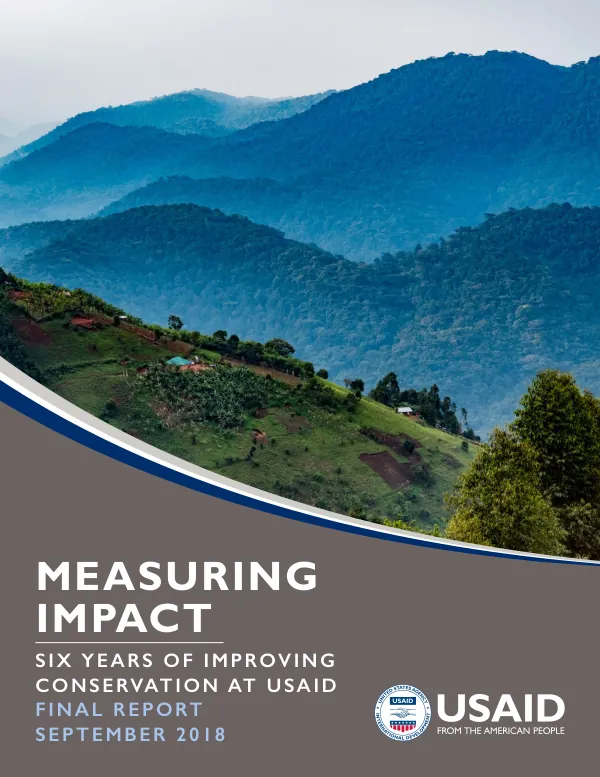
Measuring Impact Final Report: Six Years of Improving Conservation at USAID
The Measuring Impact initiative at USAID was launched in 2012 to build the Agency's capacity to implement the Biodiversity Policy and institutionalize the practice of adaptive management.
2018 · 36 pages
Sign in to readA free account is required to download.
Abstract
The initiative aimed to improve biodiversity conservation and integrated programming throughout the Agency. Over the past six years, significant progress has been made toward these goals. The initiative engaged with 20 USAID missions, providing them with a robust suite of tools and evidence to improve programming. USAID's first biodiversity cross-mission learning groups were created, actively collaborating to improve outcomes for commonly used strategic approaches. Experts across sectors were engaged to improve evidence and understanding that conservation is critical to good development outcomes. Collaboration with the Bureau for Policy, Planning, and Learning (PPL) ensured that practices support the Agency's Program Cycle Operational Policy and its emphasis on theory of change-centered programming and Collaborating, Learning and Adapting (CLA). The initiative has strengthened the systems that are fundamental to sustaining institutional change and achieving organizational effectiveness. Conservation of biodiversity is fundamental to human well-being and thus to sustainable development. Functioning natural systems are critical to human survival. The initiative has empowered people and strengthened the systems that are fundamental to sustaining institutional change and achieving organizational effectiveness. At the mission level, the initiative has improved impact through the use of a theory of change. The theory of change outlines the expected outcomes and the activities required to achieve those outcomes. The initiative has also improved impact through the use of a situation model, which outlines the current situation and the desired results. The situation model has been used to identify the key components that need to be addressed in order to achieve the desired results. At the cross-mission level, the initiative has improved impact through the use of biodiversity cross-mission learning groups. These groups have actively collaborated to improve outcomes for commonly used strategic approaches. The initiative has also improved impact through the use of experts across sectors, who have improved evidence and understanding that conservation is critical to good development outcomes. At the cross-sectoral level, the initiative has improved impact through the use of collaboration and learning. The initiative has collaborated with the Bureau for Policy, Planning, and Learning (PPL) to ensure that practices support the Agency's Program Cycle Operational Policy and its emphasis on theory of change-centered programming and Collaborating, Learning and Adapting (CLA). The initiative has also improved impact through the use of a generalized theory of change for conservation enterprises. At the Agency level, the initiative has improved impact through the use of a robust suite of tools and evidence. The initiative has provided USAID missions with a robust suite of tools and evidence to improve programming. The initiative has also improved impact through the use of a spatial monitoring and reporting tool (SMART), which has been used to monitor and report on biodiversity conservation efforts. The initiative has also improved impact through the use of a wildlife trafficking, response, assessment, and priority setting (Wildlife TRAPS) tool, which has been used to monitor and report on wildlife trafficking efforts. The initiative has also improved impact through the use of a biodiversity and watersheds improved for stronger economy and ecosystem resilience (B+WISER) tool, which has been used to monitor and report on biodiversity conservation efforts. Overall, the Measuring Impact initiative has made significant progress toward improving biodiversity conservation and integrated programming throughout the Agency. The initiative has empowered people and strengthened the systems that are fundamental to sustaining institutional change and achieving organizational effectiveness.