POPULATION COUNCIL
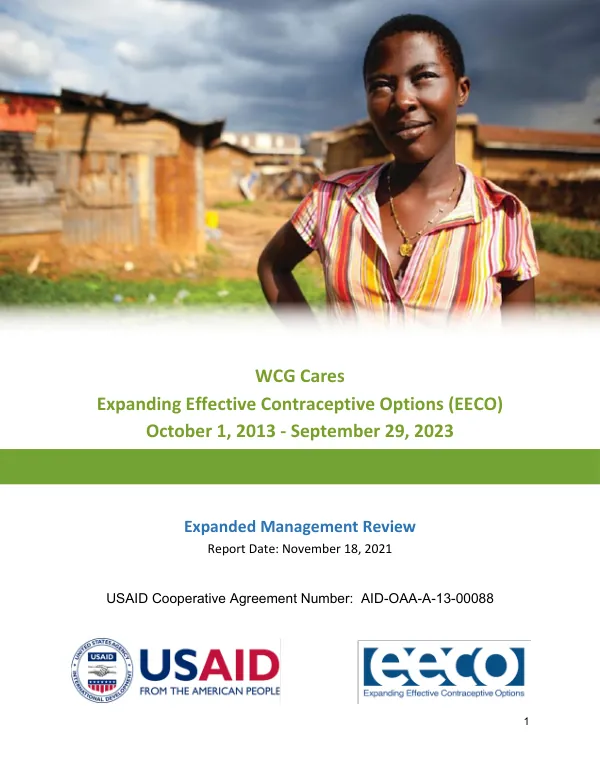
Expanding Effective Contraceptive Options (EECO) Report
The Expanding Effective Contraceptive Options (EECO) project, a USAID Cooperative Agreement, was implemented from October 1, 2013, to September 29, 2023.
2021 · 57 pages
Sign in to readA free account is required to download.
Abstract
The project aimed to expand access to effective contraceptive options in low- and middle-income countries (LMICs). EECO's primary focus was on introducing new contraceptive methods, including the hormonal intrauterine device (IUD), Caya Diaphragm, Woman's Condom, Progesterone Vaginal Ring, Modern Fertility Awareness Method (mFAM) app, and Dual Prevention Pill. EECO conducted pilot introductions and user studies in several countries, including Madagascar and Zambia. The project secured the world's first and second registrations of the Avibela hormonal IUD in Madagascar and Zambia, respectively. EECO worked closely with the Ministry of Health to train and supervise providers, resulting in over 4,860 voluntary hormonal IUD insertions in the two countries from 2017 to 2021. The project also conducted prospective longitudinal research with hormonal IUD adopters, providing evidence on client profiles, reasons for choosing the method, and continuation and satisfaction rates after 12 months of use. EECO's research found that the hormonal IUD can appeal to women regardless of their age, marital status, and parity, and that it expands the range of contraceptive options by offering attributes such as its side effect profile. The project also introduced the Caya Diaphragm, a non-medicated diaphragm, in several countries, including Kenya and Uganda. EECO's efforts led to increased adoption of the Caya Diaphragm, with over 10,000 units sold in the first year of introduction. In addition to introducing new contraceptive methods, EECO focused on improving access to existing methods. The project worked with local partners to increase the availability of modern contraceptives, including the Dual Prevention Pill, in several countries. EECO also conducted Total Market Assessments (TMAs) to identify gaps in the market and opportunities for increasing access to modern contraceptives. EECO's partnerships and collaborations played a crucial role in the project's success. The project worked closely with local governments, NGOs, and private sector entities to introduce new contraceptive methods and improve access to existing ones. EECO also collaborated with international organizations, such as the World Health Organization (WHO) and the United Nations Population Fund (UNFPA), to share best practices and leverage resources. Throughout the project's implementation, EECO faced several challenges, including regulatory barriers, limited access to funding, and the COVID-19 pandemic. However, the project successfully adapted to these challenges by revising its strategies and leveraging new resources. EECO's experience and lessons learned from the project will inform future scale-up decisions at the donor, country, and service delivery partner levels. EECO's achievements demonstrate the project's commitment to expanding access to effective contraceptive options in LMICs. The project's success in introducing new contraceptive methods and improving access to existing ones has the potential to improve reproductive health outcomes and reduce unintended pregnancies in the region.