JHPIEGO
Year 3 Work Plan for PAMO Plus
The National Malaria Elimination Strategic Plan (NMESP) 2022-2026 aims to lower the malaria burden in high-transmission settings, eliminate malaria in low-transmission settings, and prevent the reintroduction of malaria transmission in malaria-free health facility catchment areas (HFCAs).
2023 · 137 pages
Sign in to readA free account is required to download.
Abstract
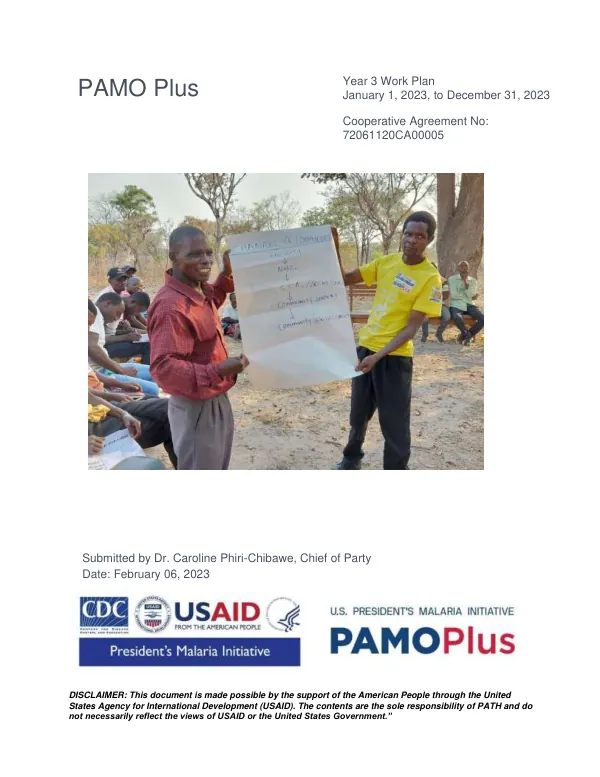
The plan was launched in August 2022 by the Government of the Republic of Zambia (GRZ) through the National Malaria Elimination Programme (NMEP). PAMO Plus, a project funded by the United States President's Malaria Initiative (PMI) and implemented by PATH in partnership with Jhpiego and the Zambia Centre for Communication Programmes (ZCCP), will engage the NMEP and support data-driven national planning while implementing malaria activities. The project will focus on five objectives: increasing the capacity of health facilities and community health workers (CHWs) to improve the quality and accessibility of malaria case management and services; increasing the accessibility and quality of services to prevent malaria in pregnancy through early antenatal care (ANC) visits; improving individual and community uptake of proven malaria control behaviors, products, and services; improving malaria surveillance data, including data from health facility and community levels, for effective, data-led decision-making; and increasing and expanding the effectiveness of malaria control measures in districts targeted by PMI's pre-elimination program. Implementation of the project will be carried out in 14 provinces and districts in Zambia, with a focus on improving malaria case management and services, increasing access to ANC services, and improving malaria surveillance data. The project will also support the implementation of the NMESP 2022-2026, which aims to eliminate malaria in low-transmission settings and prevent the reintroduction of malaria transmission in malaria-free HFCAs. The project will engage with various stakeholders, including the NMEP, the Ministry of Health, and civil society organizations, to support data-driven national planning and implement malaria activities. The project will also support the development of a comprehensive malaria surveillance system, which will provide real-time data on malaria cases and trends. The project will be implemented over a period of three years, from January 1, 2023, to December 31, 2025. The project will be managed by PATH, with Jhpiego and ZCCP serving as implementing partners. The project will be funded by PMI, with additional support from other partners. The project will focus on improving malaria case management and services, increasing access to ANC services, and improving malaria surveillance data. The project will also support the implementation of the NMESP 2022-2026, which aims to eliminate malaria in low-transmission settings and prevent the reintroduction of malaria transmission in malaria-free HFCAs. The project will engage with various stakeholders, including the NMEP, the Ministry of Health, and civil society organizations, to support data-driven national planning and implement malaria activities. The project will be implemented in 14 provinces and districts in Zambia, with a focus on improving malaria case management and services, increasing access to ANC services, and improving malaria surveillance data. The project will also support the development of a comprehensive malaria surveillance system, which will provide real-time data on malaria cases and trends. The project will be managed by PATH, with Jhpiego and ZCCP serving as implementing partners. The project will be funded by PMI, with additional support from other partners.