USAID DEC
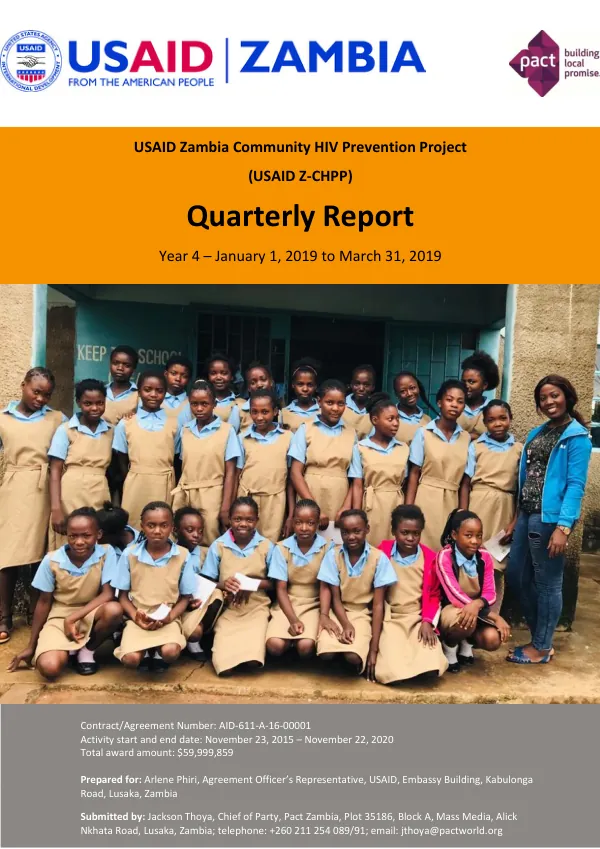
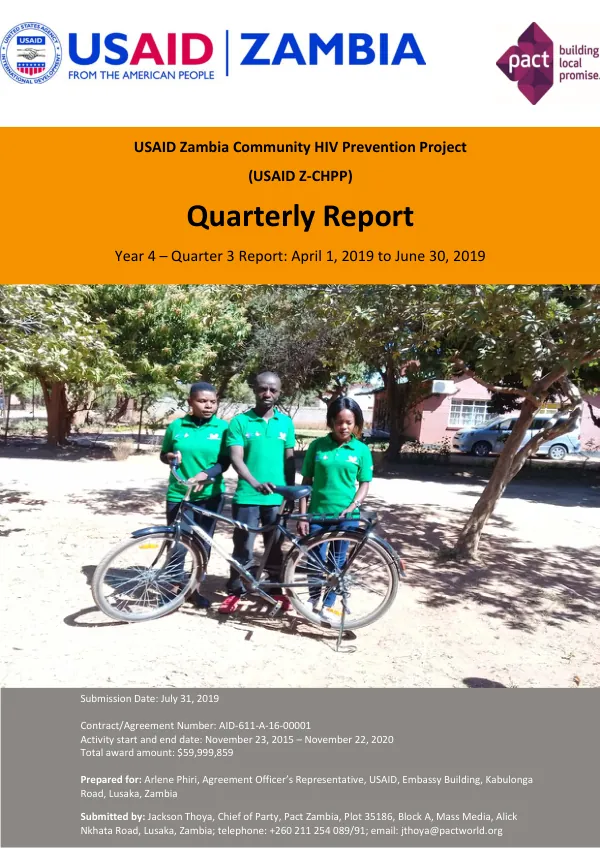
USAID Zambia Community HIV Prevention Project Quarterly Report Year 4 – Quarter 3 Report: April 1, 2019 to June 30, 2019
Sign inPACT
USAID Zambia Community HIV Prevention Project Quarterly Report Year 4 – Quarter 3 Report: April 1, 2019 to June 30, 2019
The Zambia Community HIV Prevention Project (USAID Z-CHPP) is a collaborative effort implemented by Pact in partnership with various organizations, including Plan International, Zambia Center for Communications Program (ZCCP), Catholic Medical Mission Board (CMMB), and others.
2019 · 21 pages
Sign in to readA free account is required to download.
Abstract
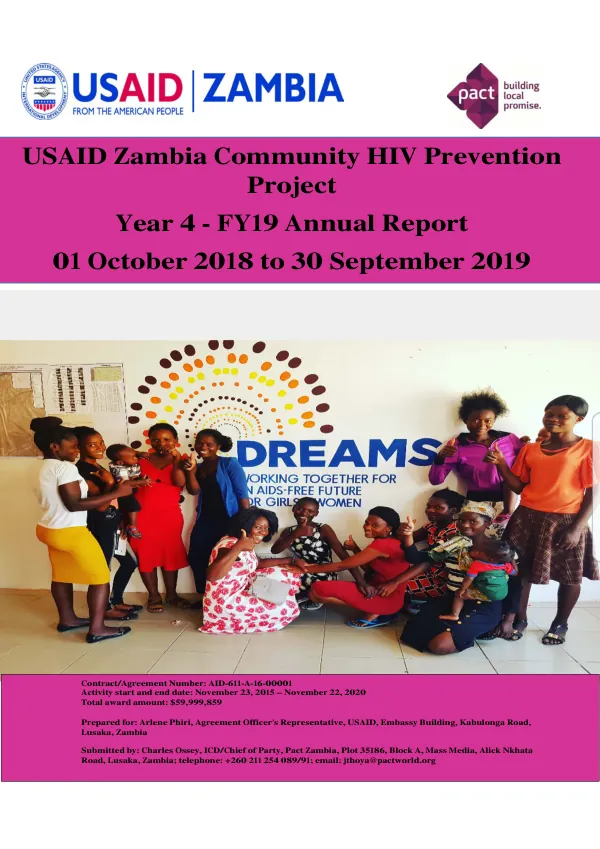
The project aims to reduce new HIV infections in Zambia by promoting increased adoption of high-impact HIV services and protective behaviors among priority populations. The project targets people living with HIV (PLHIV), discordant couples, adolescent girls and young women (AGYW), and their sexual partners, as well as other high-risk population groups such as mobile populations and non-injecting drug users. In quarter three of Fiscal Year (FY) 2019, USAID Z-CHPP contributed to the national efforts of ending AIDS by reaching priority populations with evidence-based HIV prevention interventions. The project made progress towards the UNAIDS goal of making high-risk populations know their HIV status and linking those that test HIV positive to care. USAID Z-CHPP met and surpassed its performance targets for all PEPFAR indicators and is on track to meet the key custom indicator targets by the end of FY19. Key achievements for quarter three by the strategic objectives were: * SO1: Key determinants of risky behavior reduced among priority populations. The project supported 134,785 individuals from priority populations in reducing key determinants of risky behavior by completing a standardized HIV prevention intervention package. Additionally, 1,742,163 condoms were distributed to priority populations. * SO2: Increase in completed referrals from community programs to high impact services. During the reporting period, 16,289 priority population individuals tested for HIV and received their test results. From the total tested, 1,579 tested positive and were referred for care, with 97% linked to care and initiated on treatment. * SO3: Actions adopted by communities to reduce young women's vulnerability to HIV, unintended pregnancy, and SGBV. A total of 49,854 AGYW were enrolled into the DREAMS program, with 35,581 graduating, representing a 94% achievement rate. The enrolled AGYW received services including HIV prevention, family planning, education support, economic strengthening, and Pre-Exposure Prophylaxis (PrEP). * SO4: Strengthened capacity of local stakeholders to plan, monitor, evaluate, and ensure the quality of prevention interventions. Pact provided organizational, technical, and monitoring and evaluation strengthening support to three District Health AIDS Committees (DHACs) and six local sub-partners, enabling them to effectively implement HIV response activities. The project continued to register great success in reaching its planned targets, with no major challenges reported during the reporting period. The project's efforts have contributed to the national efforts of ending AIDS and have made progress towards the UNAIDS goal of making high-risk populations know their HIV status and linking those that test HIV positive to care.