USAID
Yemen Communities Stronger Together (YCST) Monthly Program Update – November 2019
The addition of new staff and the first annual learning workshop in November 2019 provided momentum for implementation of the Yemen Communities Stronger Together (YCST) program.
2019 · 5 pages
Sign in to readA free account is required to download.
Abstract
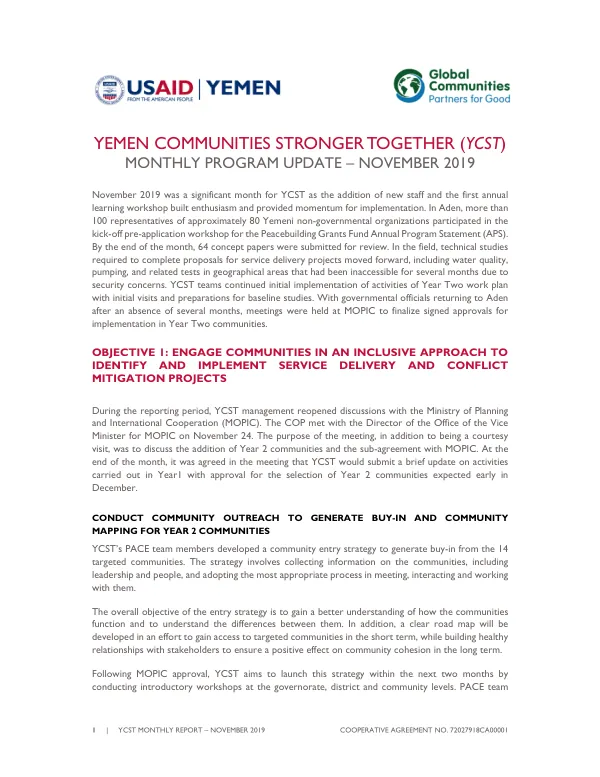
In Aden, more than 100 representatives of approximately 80 Yemeni non-governmental organizations participated in the kick-off pre-application workshop for the Peacebuilding Grants Fund Annual Program Statement (APS). By the end of the month, 64 concept papers were submitted for review. In the field, technical studies required to complete proposals for service delivery projects moved forward, including water quality, pumping, and related tests in geographical areas that had been inaccessible for several months due to security concerns. YCST teams continued initial implementation of activities of Year Two work plan with initial visits and preparations for baseline studies. With governmental officials returning to Aden after an absence of several months, meetings were held at MOPIC to finalize signed approvals for implementation in Year Two communities. The COP met with the Director of the Office of the Vice Minister for MOPIC on November 24 to discuss the addition of Year 2 communities and the sub-agreement with MOPIC. It was agreed that YCST would submit a brief update on activities carried out in Year 1 with approval for the selection of Year 2 communities expected early in December. Community outreach to generate buy-in and community mapping for Year 2 communities was a key objective. YCST's PACE team members developed a community entry strategy to collect information on the communities, including leadership and people, and to adopt the most appropriate process in meeting, interacting, and working with them. The overall objective of the entry strategy was to gain a better understanding of how the communities function and to understand the differences between them. A clear road map was developed to gain access to targeted communities in the short term, while building healthy relationships with stakeholders to ensure a positive effect on community cohesion in the long term. Initial visits were conducted to the 14 targeted communities in Aden, Abyan, and Lahj governorates to determine geographic locations and to obtain real and updated population numbers. Local leaders, including Sheikhs and Aqel harah, were interviewed to obtain data for the targeted communities that will be used in developing community profiles for these communities. The PACE team finalized the Focus Group Discussion (FGD) form, which includes questions with regards to socio-demographics, availability of basic services, social capital, drivers of conflict, community security, local governance, and community priorities. The FGD questionnaire will be used to obtain primary source data from members of each of the new 14 communities. The CEC and local community members of the Al Mahfad district in Abyan engaged in a systematic participatory discussion resulting in the development of a prioritized list of community stressors. Lack of a sufficient quantity of potable water due to the lack of funds for expensive and scarce diesel fuel was identified as a top priority. In response, YCST aims to implement the Al Mahfad Water Supply Enhancement Project (MWSEP), which will replace two diesel-operated water pumps with two solar-powered submersible and energy-efficient water pumps as well as installing a solar energy system. This proposed project will mitigate conflict amongst community members by increasing water production at lowered cost. Comparable to the above projects, technical design documents (including Environmental Impact Assessments (EIAs), Bills of Quantities (BoQs), and drawings) were drafted during this reporting month for the Ras Al Aarah WASH and Solar Energy Project, located in the Ras Al-Aarah, and the Al-Soqaya and the Al-Nabyah WASH and Solar Energy Project. Both of these locations are in the Al Madharibah Wa Al Arah district, Lahj governorate.