GLOBAL COMMUNITIES
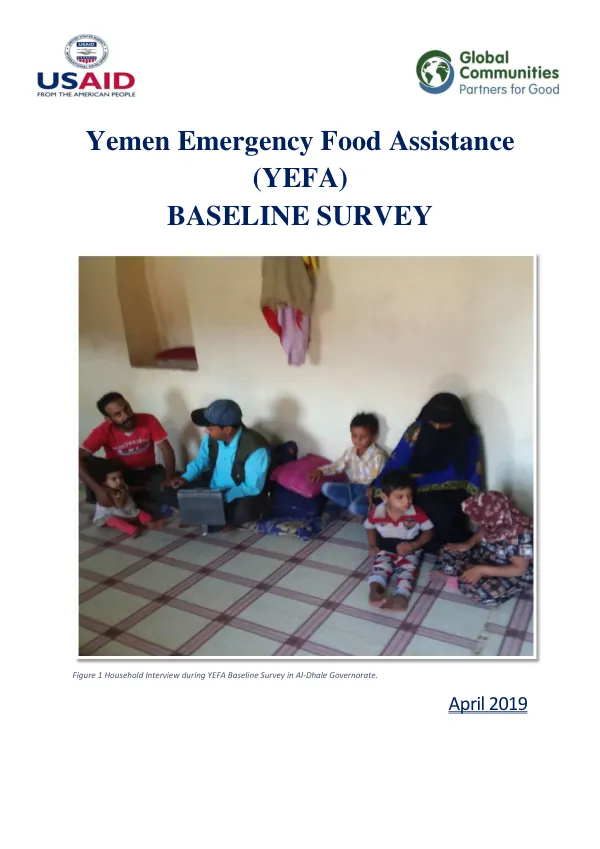
Yemen Emergency Food Assistance (YEFA) BASELINE SURVEY
The Yemen Emergency Food Assistance (YEFA) program is a humanitarian initiative aimed at reducing the risk of morbidity and mortality associated with extreme food insecurity amongst vulnerable households in Yemen.
2019 · 14 pages
Sign in to readA free account is required to download.
Abstract
The program is implemented by Global Communities in collaboration with other humanitarian actors to provide lifesaving food assistance to the most vulnerable host community and IDP households. The baseline survey conducted in April 2019 aimed to establish a pre-project measurement of key results' indicators outlined in the Logical Framework matrix. The survey targeted 710 households in the working areas of YEFA in Aden, Al-Dhale, IBB, and Dhamar Governorates. The assessment provided first-hand information on food, income patterns, food consumption score, household diet diversity score, household hunger scale, minimum dietary diversity of women, and coping strategies. The survey revealed that 35% of households reported poor food consumption scores, while 43% reported borderline scores, and 22% reported acceptable scores. The average Household Dietary Diversity Score (HDDS) of the households surveyed in all governorates was 4.9, with 53% of households reporting poor HDDS, 41% reporting moderate HDDS, and 6% reporting acceptable HDDS. Additionally, 76% of respondents reported little or no hunger, and 74.5% of women respondents consumed less than five food groups. The baseline data confirmed that the food security status of the districts is low, as expected. The YEFA program aims to deliver lifesaving food assistance to 3,825 of the most vulnerable host community and IDP households through market-based interventions using food vouchers. The program's key objectives include setting a benchmark for Food Consumption Scores (FCS), establishing the current Household Dietary Diversity Scores (HDDS) and Household Hunger Scale (HHS), and confirming household access to markets and the feasibility of a food assistance program. The study methodology involved a non-experimental design approach, where a total of 710 sampled individuals were selected randomly from the target beneficiaries. A two-stage purposive sampling procedure was employed, where the district was selected considering YEFA project intervention areas, and 710 project beneficiaries were drawn using simple random sampling method. The survey team collected data using smartphones via a Fulcrum software application, and structured and semi-structured interviewing techniques were used. The data analysis involved descriptive statistics, where frequency, percentage, mean, etc. were used to carry out data analysis and to evaluate the baseline evaluation data. Conceptual generalizations were used to analyze qualitative data. The results of the baseline survey will serve as a guide for project implementation and as a basis against which the level of attainment of milestones and targets will be compared during the end-line survey and final evaluation.
Related documents