CATHOLIC RELIEF SERVICES ORGANIZATION
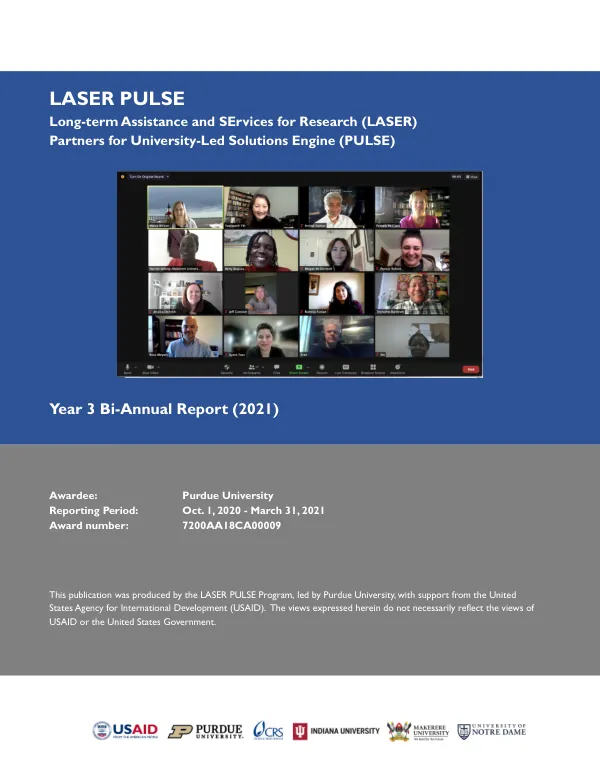
Final_LASER FY2021 Mid-year Bi-annual Performance Report
The LASER PULSE program is a five-year, $70-million initiative funded by USAID's Innovation, Technology, and Research Hub.
2021 · 21 pages
Sign in to readA free account is required to download.
Abstract
The program delivers research-driven solutions to field-sourced development challenges in USAID partner countries. A consortium led by Purdue University, with core partners Catholic Relief Services, Indiana University, Makerere University, and the University of Notre Dame, implements the LASER PULSE program through a network of researchers and development practitioners in 61 countries. The program currently manages 16 research awards in 14 countries. The Innovation, Technology, and Research Hub leads USAID in original experimentation, using data and evidence in decision-making, harnessing scientific and technological advances, open innovation, and digital technology to transform development. The LASER network offers its members access to a large database of researchers and practitioners worldwide, as well as online resources, newsletters, and funding opportunities. However, the program has faced challenges in networking among members, with most networking occurring in-person at Research for Development conferences, which were suspended due to the COVID-19 pandemic. To address this, LASER plans to create a strategy for active and engaged networking among members in Year 4. The program has also learned the importance of close engagement with USAID Missions in identifying research problems, with successful collaborations resulting in strengthened relationships and high participation in program events. The LASER PULSE program has received a high volume of strong concept notes and applications for its RFAs, surpassing initial expectations. The program has also been able to identify and engage excellent research teams, including women, who are underrepresented among researchers in several USAID regions. LASER has utilized the Comprehensive Success Factor Analysis (CSFA) process to identify key research questions independently of USAID Missions, and has replicated this process with successful results in several countries. The program has made significant progress in its first three years, with a strong focus on research-driven solutions to development challenges. The LASER PULSE program continues to evolve and adapt to the needs of its partners and stakeholders, with a commitment to delivering high-quality research and development outcomes. The program's success has been recognized through appreciative notes and emails from USAID Missions, highlighting the importance of close collaboration and co-creation in achieving development goals. The LASER PULSE program's research awards have focused on a range of topics, including youth development, migration, and rural development. The program has also prioritized the inclusion of women and minority groups in its research and development activities, with a focus on addressing the underrepresentation of women among researchers in several USAID regions. Through its research and development activities, the LASER PULSE program aims to contribute to the transformation of development practices and outcomes in USAID partner countries. The program's monitoring, evaluation, and learning (MEL) framework has been instrumental in tracking progress and identifying areas for improvement. The framework has enabled the program to assess its performance against indicators and life-of-project targets, and to make adjustments as needed. The LASER PULSE program's MEL framework is designed to be adaptive and responsive to changing program needs and priorities. The program's engagement with partners has been a key factor in its success, with a strong focus on building relationships and collaborations with USAID Missions, HEIs, and development organizations. The LASER PULSE program has established partnerships with a range of organizations, including Catholic Relief Services, Indiana University, Makerere University, and the University of Notre Dame, to name a few. These partnerships have enabled the program to leverage expertise and resources, and to deliver high-quality research and development outcomes. The LASER PULSE program's environmental monitoring framework has been designed to track the environmental impacts of its research and development activities. The framework has enabled the program to assess its performance against environmental indicators and to make adjustments as needed. The program's environmental monitoring framework is designed to be adaptive and responsive to changing program needs and priorities. The program's gender and social inclusion considerations have been a key focus area, with a strong emphasis on addressing the underrepresentation of women among researchers in several USAID regions. The LASER PULSE program has prioritized the inclusion of women and minority groups in its research and development activities, and has established partnerships with organizations that share this goal. Through its research and development activities, the program aims to contribute to the transformation of development practices and outcomes in USAID partner countries.
Related documents