USAID DEC
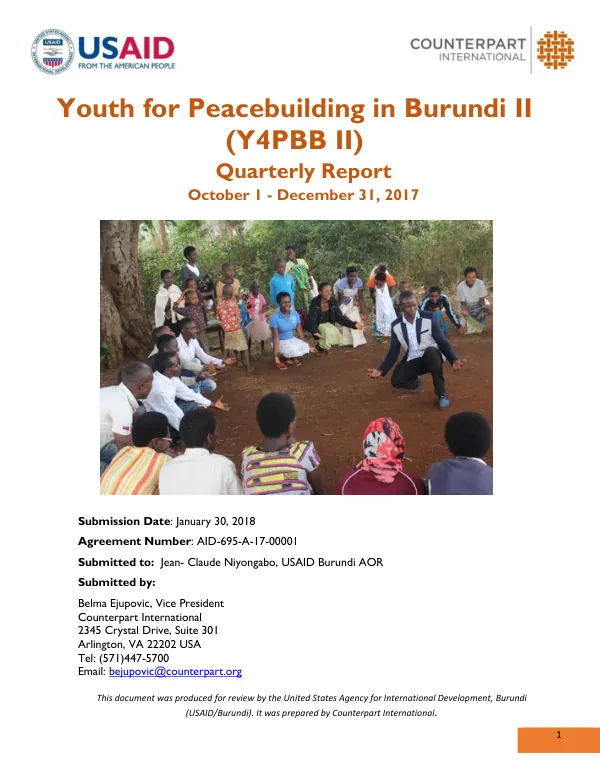
Youth for Peacebuilding in Burundi II (Y4PBB II) Quarterly Report: October 1 – December 31, 2017
Sign inCOUNTER PART INTERNATIONAL
Youth for Peacebuilding in Burundi II (Y4PBB II) Quarterly Report: October 1 – December 31, 2017
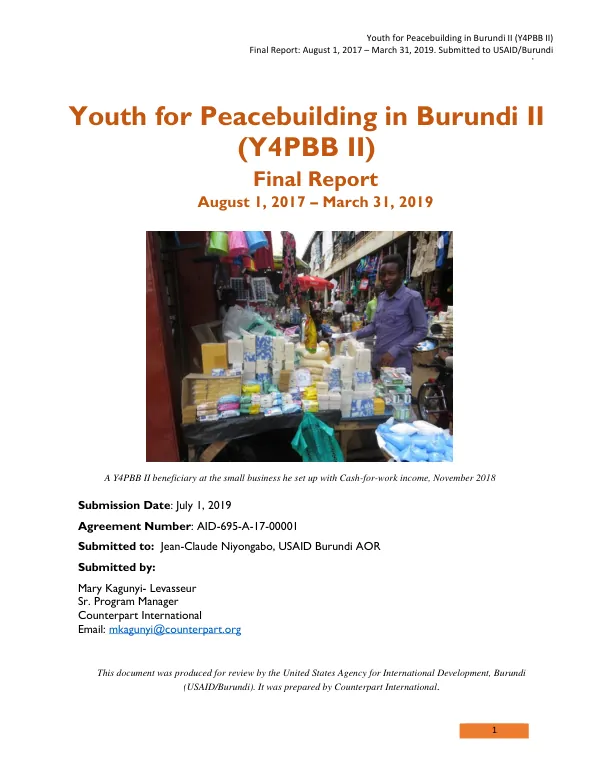
The Youth for Peacebuilding in Burundi II (Y4PBB II) program is a follow-on to the Youth for Peace-building in Burundi program, implemented from July 2014 to July 2017.
2018 · 26 pages
Sign in to readA free account is required to download.
Abstract
The program aims to lower the risk of youth participation in violence in Burundi and provide alternative long-term socio-economic opportunities for young people (ages 18 to 35 years old) for positive civic engagement and income generation. The program's goal is supported by three interrelated objectives: 1) Build the capacity of local Civil Society Organization (CSOs) to empower and support youth-led, positive civic engagement; 2) Enhance economic incentives for youth to participate constructively in society; and 3) Support youth-led peacebuilding and violence prevention activities. The Y4PBB II Theory of Change proposes that if positive alternative livelihood opportunities and peacebuilding skills are improved for youth, and the enabling environment for economic opportunities and participation in governance is also improved to better include youth, then youth, especially those in high-risk areas, will be less likely to become involved in violent conflict, and can better contribute to peace and stability in Burundi. The program will strengthen the organizational capacity of its partners and, through sub-awards to these partners, will support youth-led advocacy at the communal/municipal and national levels, provide long-term socio-economic opportunities for young people through entrepreneurship and vocational trainings, facilitate access to startup capital, support youth-led grassroots dialogues and outreach activities, and promote cross-learning through exchange of experiences on entrepreneurship. During the quarter, activities were implemented across all three of Y4PBB II's objectives. Counterpart International developed CSO partners' organizational capacities, laid the groundwork for advocacy networks and the program's economic activities. The quarter was marked by a consistent ground-level focus on setting up Y4PBB II grantees for success. The first priority was issuing the sub-award to the third CSO partner, Centre d'Encadrement et de Développement des Anciens combattants (CEDAC), a key partner supporting Parole et Action pour le Réveil des Consciences et l'Evolution de Mentalités (PARCEM) in the development of communal and local youth advocacy networks throughout the country as well as leading on the local dialogues. The overall capacity building of Y4PBB II grantees was another focus during the quarter. To that end, Y4PBB II instituted a series of actions to support the development of the program's grantees. For example, all grantees participated in an Organizational Capacity Assessment (OCA) to establish a baseline for reviewing progress over the course of their grant. Additionally, since Y4PBB II is committed to developing a strong, locally-owned gender focus among its partners, the program assisted, through a local consultant, in the review and development of gender action plans for all grantees. To prepare for advocacy work, Y4PBB II, through grantees PARCEM and CEDAC, trained their communal focal points in effective advocacy techniques and leadership. These trainers then facilitated workshops for municipal and local networks to build local advocacy capabilities. To set the stage for increased access to microfinance, Y4PBB II, through a sub-award to Jumelage Jeunesse du Burundi (JJB) implemented a series of activities: a baseline survey of beneficiaries was completed, Entrepreneurship Learning Exchange Days (ELEDs) for new beneficiaries to meet with recipients were carried out, and new beneficiaries were instructed on the creation of business plans, which was followed by intensive coaching on those plans with the goal of producing long-term, viable income-generating activities. The program aims to reach more than 2,000 direct beneficiaries and 4,400 indirect beneficiaries through outreach activities and public information campaigns. These activities will be implemented in areas that were identified as "hotspots" of conflict prior to the 2015 elections where limited conflict prevention initiatives were taking place and where challenges for youth remain rife. These areas include twelve selected rural communes of the provinces of Kayanza, Ngozi, Gitega, Karuzi, Ruyigi, and Rutana, as well as in Bujumbura Mairie. The program's implementation is ongoing, with a focus on building the capacity of local CSOs, enhancing economic incentives for youth, and supporting youth-led peacebuilding and violence prevention activities. The program's Theory of Change proposes that by improving positive alternative livelihood opportunities and peacebuilding skills for youth, and improving the enabling environment for economic opportunities and participation in governance, youth will be less likely to become involved in violent conflict and can better contribute to peace and stability in Burundi.