CENTER FOR EDUCATIONAL DEVELOPMENT
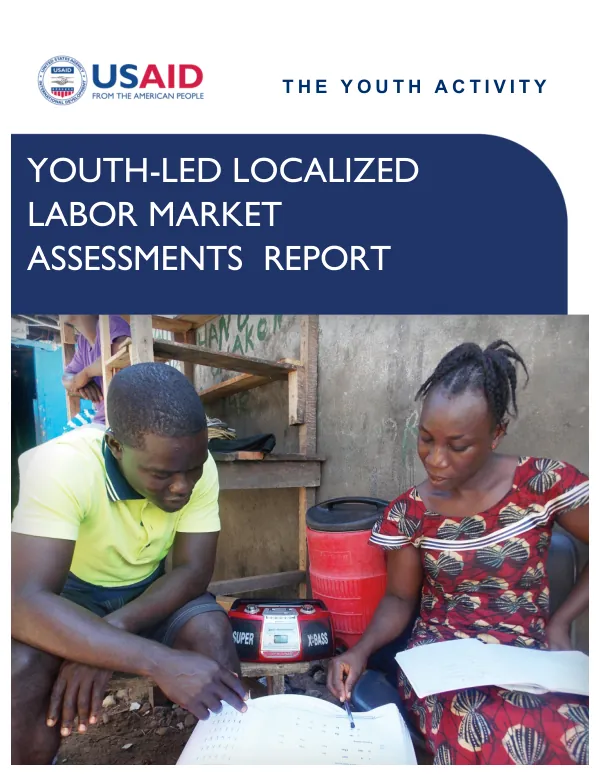
Youth-Led Localized Labor Market Assessments Report
The Youth Activity, a program aimed at increasing the economic self-reliance and resiliency of Liberian youth, initiated a Youth-Led Local Labour Market Assessment (LLMA) to achieve its objectives.
2021 · 43 pages
Sign in to readA free account is required to download.
Abstract
The LLMA was conducted between September and November 2021 in three counties: Montserrado, Grand Bassa, and Lofa. Young people acted as Youth Coordinators and Youth Researchers to gather information from more than 70 key informants in these counties. The assessment aimed to understand the local economy, labor realities of young people, local labor opportunities, hiring trends, skills in demand for young people, and constraints facing youth. The findings revealed that young people across the three locations are interested in being self-employed due to limited wage employment opportunities. The young people who are self-employed are involved in petty trade or 'hand to mouth' business, which are often seasonal in nature. To be more productive in self-employment, youth need to acquire entrepreneurship, business development, and financial literacy skills. In a country where the government is the highest employer and with very limited presence of large private businesses, wage employment opportunities are limited. The few wage employment opportunities that youths are exposed to require hard skills as well as the necessary soft skills. Young people will also need to use their contacts/networks to gain easy access to entry-level positions. With the current gap of hard skills and soft skills among young people across the three locations, the road to wage employment for young people is still an uphill task. The assessment identified key sectors for vocational training courses that could better equip youth to enter the labor market, including construction, manufacturing, agriculture, hospitality, service, transportation, and ICT. The findings also highlighted the need for sexual reproductive health and psychosocial education among young women, as well as the importance of aligning trainings to youth needs and availability. The LLMA researchers observed that there were very few disabled young people in the various communities where the assessment was conducted. The few persons whom they encountered were either blind and/or physically disabled. The researchers also gathered that there were very few training facilities that are accessible to the physically challenged, and those available are located essentially in the capital cities or major towns. Based on the analysis of the entry-level business ideas, the assessment recommended focusing on key economic sectors within the three counties, supporting entry-level jobs, income-generating activities, and other opportunities for youth in relevant sectors. The assessment also recommended continuing to use community mapping, informational interviews, and observation to help TYA staff and youth better understand the economic context of their communities. Additionally, the assessment recommended developing a strategy to support young women and ensuring the next TYA LLMA focuses more on youth with disabilities. The LLMA findings will provide initial insight into the local economic setting of the three counties and give the TYA team an understanding of the local context through the eyes of the youth. These findings will set the pace for real youth impact and inform the TYA approach in a manner that is both context-relevant and sustainable.
Related documents