USAID DEC
Youth Targeting Tool Workshop Session
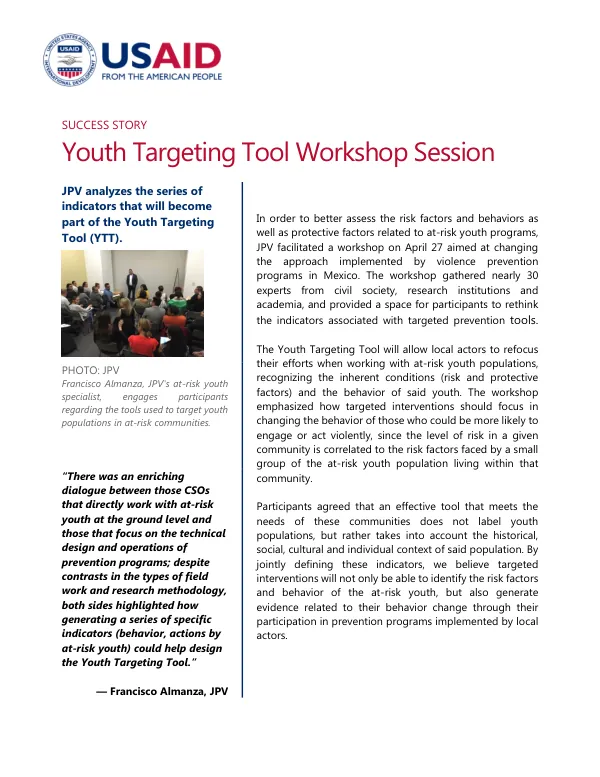
The Youth Targeting Tool Workshop Session was facilitated by JPV on April 27, bringing together nearly 30 experts from civil society, research institutions, and academia.
2016 · 1 pages
Sign in to readA free account is required to download.
Abstract
The primary objective of the workshop was to reevaluate the indicators associated with targeted prevention tools for at-risk youth programs in Mexico. This effort aimed to improve the assessment of risk factors and behaviors, as well as protective factors, related to these programs. The workshop emphasized the importance of recognizing the inherent conditions and behavior of at-risk youth populations. It highlighted that targeted interventions should focus on changing the behavior of those who are more likely to engage or act violently, as the level of risk in a community is correlated to the risk factors faced by a small group of at-risk youth living within that community. Participants agreed that an effective tool should not label youth populations but rather take into account the historical, social, cultural, and individual context of the population. The Youth Targeting Tool is designed to enable local actors to refocus their efforts when working with at-risk youth populations. By jointly defining indicators, targeted interventions will be able to identify risk factors and behavior of at-risk youth and generate evidence related to their behavior change through participation in prevention programs implemented by local actors. The tool is expected to provide a more nuanced understanding of the complex issues surrounding at-risk youth populations. The workshop facilitated an enriching dialogue between civil society organizations that directly work with at-risk youth and those that focus on the technical design and operations of prevention programs. Despite contrasts in field work and research methodology, both sides highlighted the potential benefits of generating a series of specific indicators to help design the Youth Targeting Tool. This collaborative approach is expected to lead to more effective targeted interventions and improved outcomes for at-risk youth populations. The development of the Youth Targeting Tool is a critical step towards improving the effectiveness of prevention programs for at-risk youth in Mexico. By taking a more nuanced and context-specific approach, local actors will be better equipped to address the complex issues surrounding at-risk youth populations and provide targeted support to those who need it most.
Related documents