USAID DEC
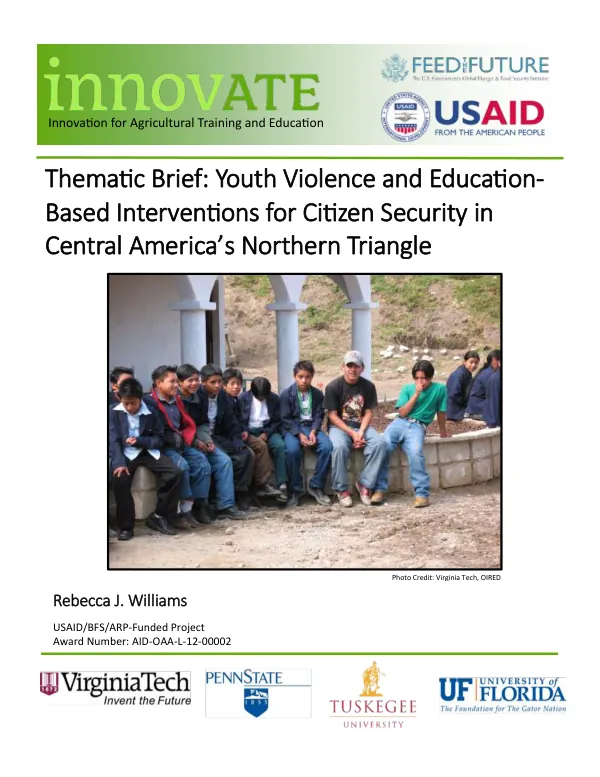
Youth Violence and Education-Based Interventions for Citizen Security in Central America’s Northern Triangle
Sign inUSAID
Youth Violence and Education-Based Interventions for Citizen Security in Central America’s Northern Triangle
Youth violence and education-based interventions are critical components in addressing citizen security in Central America's Northern Triangle.
2016 · 9 pages
Sign in to readA free account is required to download.
Abstract
The region, comprising El Salvador, Guatemala, and Honduras, has experienced a significant increase in violence, with intentional homicide rates exceeding those of lower-middle-income countries worldwide. Men, particularly young men, are predominantly perpetrators of crimes, with a large number of crimes committed by those in the 15-29 age range. The impact of violence on households is profound, with costs including medical care, loss of productivity, legal services, and psychological impacts. Agricultural workers are particularly vulnerable, as physical injury can be detrimental to their ability to work. The indirect psychological effects of violence have lasting impacts on development, as people adopt avoidance behaviors such as limiting mobility and access to services. The flow of drugs through the region has not resulted in a decrease in violence, as contending groups now have conflict over fewer routes and territories. The value of cocaine as a share of GDP is significant, with estimates ranging from 11 to 14.2 percent in Guatemala and Honduras, respectively. In El Salvador, the cost of violent crime is estimated at 1.7 billion dollars per year, with gang violence accounting for 60 percent of the total. High levels of crime and violence deter investment activity, particularly from foreign direct investors. A survey of constraints to business in Guatemala revealed that crime and corruption are the biggest risks to business, with over 80 percent of businesses stating that crime is a major deterrent. The lack of efficacy and distrust in the police systems has led to a significant privatization of security, which privileges the wealthy but leaves the poor without a defender. The justice and penal systems in the Northern Triangle countries are known to be recruitment camps and training grounds for gang participation and narcotraffickers. The prison systems are extremely overcrowded and have been accused of human rights violations, including mental and physical abuse. The combination of poor law enforcement systems, the failure of judicial systems, and the known issues of the penal systems leads to an environment of near lawlessness in the Northern Triangle nations, primarily targeted at the poor. Education-based interventions are highly successful as a preventative measure for youth violence. Studies have shown that higher levels of education are correlated with lower levels of violence, and the completion of secondary education is highly correlated with greater access to economic and social opportunity. Improving the relationship between teachers and students, increasing the relevance of education, and bolstering student self-esteem are critical components of effective education-based interventions. Innovative approaches to education, such as vocational training and life skills education, have been shown to be effective in reducing youth violence. Additionally, community-based initiatives that focus on building social capital and promoting positive relationships between youth and community members have been successful in reducing violence. A multi-sectoral and multi-level approach that incorporates education-based interventions, community-based initiatives, and economic development strategies is necessary to address the complex issue of youth violence in the Northern Triangle.
Related documents