USAID DEC
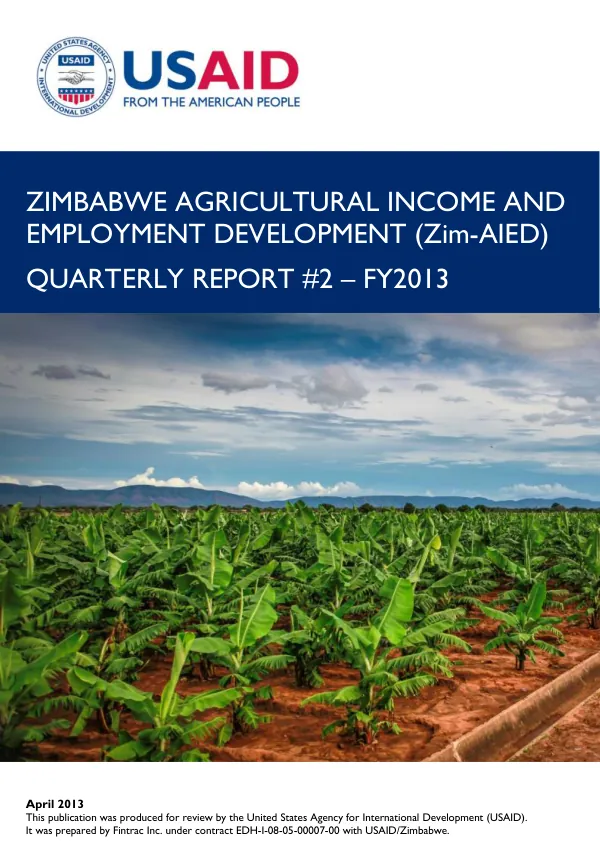
Zimbabwe Agricultural Income and Employment Development (Zim-AIED) Quarterly Report #2 – FY2013
Sign inFINTRAC
Zimbabwe Agricultural Income and Employment Development (Zim-AIED) Quarterly Report #2 – FY2013
The Zimbabwe Agricultural Income and Employment Development (Zim-AIED) program is a technical assistance initiative aimed at improving food security and increasing incomes of rural households.
2013 · 42 pages
Sign in to readA free account is required to download.
Abstract
The program began in October 2010 and will run through February 2015. Zim-AIED is providing technical assistance to farmers in all agro-ecological regions, with a focus on specific low-income areas where farmers have the potential to move from subsistence to small-scale commercial agriculture. The program's objectives are to increase agricultural productivity, improve market access, and enhance the overall economic well-being of rural households. To achieve these objectives, Zim-AIED is implementing a range of activities, including farmer training, infrastructure development, and market linkage facilitation. The program is also providing support for the development of business plans, investment in new technologies, and the adoption of sustainable agricultural practices. One of the key areas of focus for Zim-AIED is the development of irrigation schemes. The program has assisted in the establishment of several irrigation schemes, including the Mutema & Chibuwe irrigation schemes in Manicaland, which is expected to earn more than $1.8 million in revenue. The program is also providing support for the development of horticulture, paprika and chilies, and export horticulture, as well as livestock and irrigation. In terms of productivity, Zim-AIED has reported significant improvements in staple food crops, horticulture, and livestock. The program has also reported increases in gross margin and net income for participating farmers. In addition, Zim-AIED has provided support for the development of business plans, investment in new technologies, and the adoption of sustainable agricultural practices. The program has also made significant progress in addressing climate change and environmental issues. Zim-AIED has implemented a range of activities aimed at reducing the environmental impact of agricultural practices, including the promotion of conservation agriculture and the use of environmentally friendly inputs. In terms of gender, Zim-AIED has reported significant progress in increasing the participation of women in agricultural activities. The program has provided training and support for women farmers, and has reported increases in the number of women participating in agricultural activities. Despite the progress made by Zim-AIED, the program has also faced several challenges, including limited access to finance and credit, as well as the impact of climate change on agricultural productivity. However, the program has reported significant lessons learned, including the importance of building strong relationships with farmers and other stakeholders, and the need for ongoing support and training to ensure the long-term sustainability of agricultural activities. In conclusion, Zim-AIED has made significant progress in improving food security and increasing incomes of rural households in Zimbabwe. The program's focus on technical assistance, infrastructure development, and market linkage facilitation has helped to increase agricultural productivity and improve market access. However, the program continues to face several challenges, and will require ongoing support and resources to ensure its long-term sustainability.