USAID MOMENTUM
Complexity-Aware Monitoring Approaches for MOMENTUM Projects: A Guide
This document is a technical guide for complexity-aware monitoring approaches for MOMENTUM projects.
2020
Sign in to readA free account is required to download.
Abstract
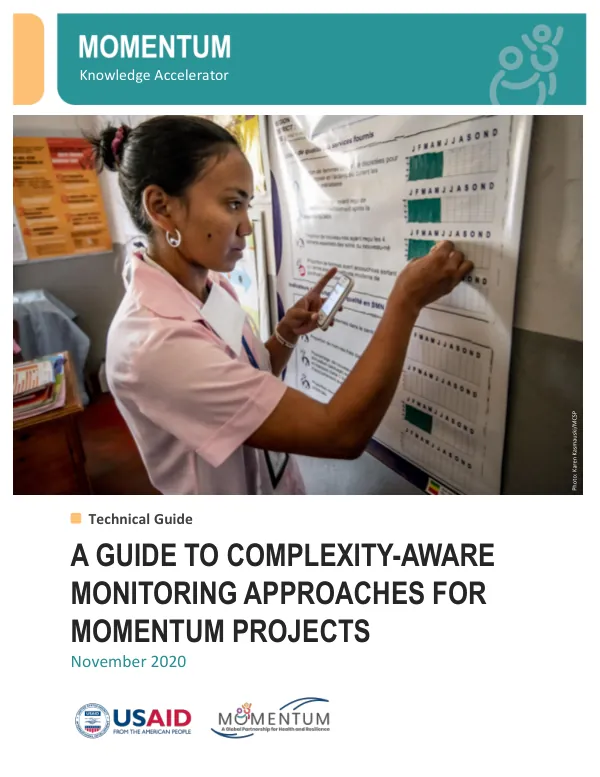
MOMENTUM is a USAID-funded program aimed at accelerating reductions in maternal, newborn, and child mortality and morbidity in high-burden USAID priority countries. The guide provides an introduction to key concepts associated with complexity-aware monitoring, guidance on applying these approaches to MOMENTUM projects, a summary matrix for comparing selected approaches, and resources to support their use. The guide is intended for MOMENTUM implementers, including global, country, and field awardees, as well as USAID counterparts. It is specifically designed for M&E staff, project leadership, and project or activity managers, but may also be useful for technical or program staff. The document covers various topics, including: 1. Glossary of key terms related to complexity-aware monitoring 2. Overview and introduction to complexity-aware monitoring approaches 3. Understanding complexity and when to use complexity-aware monitoring 4. How complexity-aware monitoring integrates with traditional M&E 5. Questions that complexity-aware monitoring can address 6. Relationship between complexity-aware monitoring and adaptive learning 7. Application of complexity-aware monitoring approaches to MOMENTUM projects 8. Recommended approaches, including social network analysis, causal link monitoring, outcome mapping, sentinel indicators, pause and reflect, outcome harvesting, most significant change, ripple effects mapping, and contribution analysis. The guide provides a comprehensive resource for MOMENTUM partners to use complexity-aware monitoring approaches to enhance their monitoring and evaluation and adaptive learning, thereby improving the likelihood of project success.
Related documents