SAFERWORLD
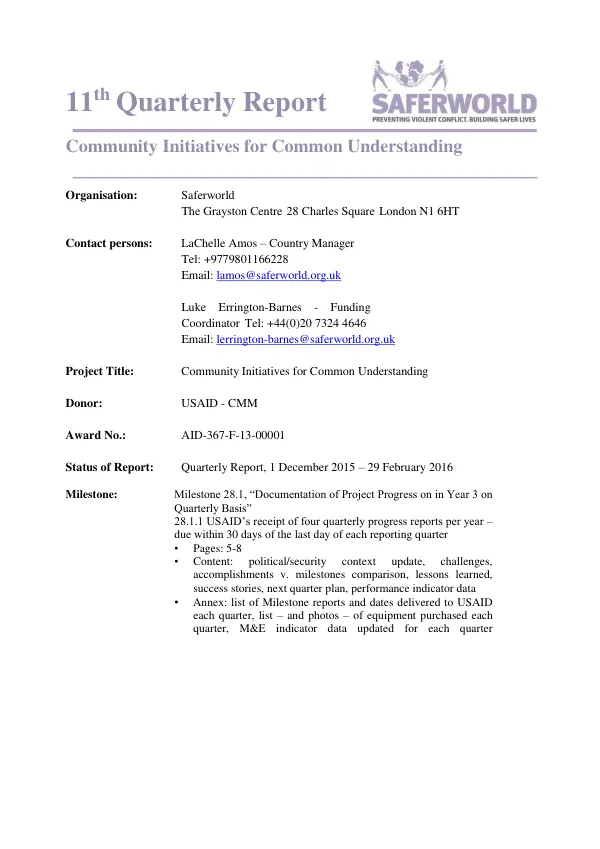
11th Quarterly Report: Community Initiatives for Common Understanding
The Community Initiatives for Common Understanding project in Nepal began in 2013 with funding from USAID's Conflict Mitigation and Management program.
2016 · 13 pages
Sign in to readA free account is required to download.
Abstract
The project aims to contribute to an environment shaped by trust and strong social ties between communities, including conflicting groups and local authorities, making them resilient to social divides, insecurity, and conflict. The project has three expected results: breaking down barriers to peaceful dialogue, increasing mutual understanding and appreciation of grievances between conflicting groups, and enabling conflicting groups to identify activities for development and reconciliation and collaborate toward their implementation. The project focuses on 9,000 hard-to-reach and at-risk young people, including former combatants, in five districts of Nepal: Kailali, Surkhet, Banke, Bardiya, and Sunsari. Secondary audiences for the project are government stakeholders and decision-makers at the district and national level. The project targets 3 VDCs in each district, with a community-based approach. During the reporting period, the intensity of protests in the Terai gradually decreased, but a violent clash between Madeshi protestors and security forces claimed 3 lives in Rangeli, Morang. The unofficial blockade was eventually lifted, facilitating the official visit of Prime Minister KP Oli to India. The political context was dominated by Nepali Congress, with preparations for their general convention starting in early March. Madeshi Morcha announced a fresh protest program, including lathi demonstrations, protest assemblies, and blocking highways. The project has made progress in achieving its expected results. Activities under Milestone 6, 10, and 16 were completed, and progress was made towards achieving Milestone 5, 14, 15, and 25. The project has identified at least 200 hard-to-reach and at-risk youth from the working VDCs, who have been targeted for reconciliation and social harmony activities. These youth have been engaged in activities such as sports, community interaction, training, and cultural activities, as well as working cooperatively as RDF and Youth Group members to implement RDF and Youth Group Action plan activities. The project has facilitated the formation of 15 self-help groups in 15 working VDCs, with 150 at-risk and hard-to-reach youth engaged in the group for monthly saving and credit activities to support each other, as well as individual entrepreneurship activities. During the reporting period, they extended their linkages with local cooperatives for additional financial support to sustain the entrepreneurship activities in which they have been involved. Psycho-social group interventions were conducted in three VDCs, facilitated by experienced local counsellors with the support of those that participated in the 'Basic Psycho-social Support and Care ToT'. Altogether 121 community people participated in the group interventions aimed at raising awareness of community members on psycho-social health, introducing services available locally, identifying psycho-social problems on individuals followed by counselling support, and referring complicated cases to district facilities. After the group intervention, 22 individuals from Singhiya and Binauna received psycho-social counselling, and 16 individuals received psycho-social support in Kailka VDC, Bardiya. The project has also made progress in identifying informal justice mechanisms in each VDC. Field research was completed in all five working districts, and the data was analysed and validated to produce a draft Justice Mapping Report. The report will be shared as a Milestone report to USAID in April 2016.
Related documents