USAID DEC
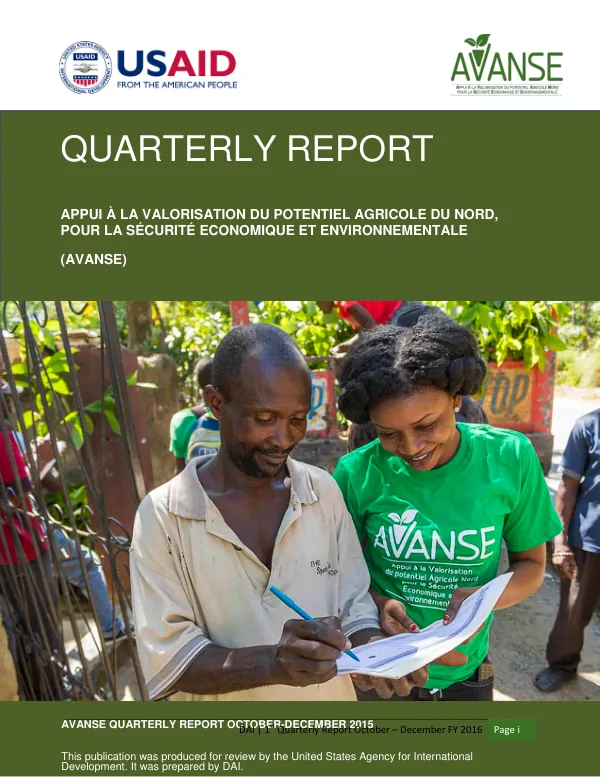
1st Quarterly Report October – December FY 2016: Appui à la Valorisation du potentiel Agricole du Nord, pour la Sécurité Économique et Environnementale (AVANSE)
Sign inDAI
1st Quarterly Report October – December FY 2016: Appui à la Valorisation du potentiel Agricole du Nord, pour la Sécurité Économique et Environnementale (AVANSE)
The agricultural development initiative in Haiti, known as AVANSE, aims to increase agricultural production, improve watershed stability, and strengthen agricultural markets.
2016 · 45 pages
Sign in to readA free account is required to download.
Abstract
The project is funded by the United States Agency for International Development (USAID) and implemented by DAI. AVANSE focuses on three value chains: rice, banana/plantain, and cacao. During the first quarter of fiscal year 2016, AVANSE implemented various activities to achieve its objectives. In the rice value chain, training was conducted for 1,500 farmers, and 50 kg sacks of seeds were distributed to 15 farmer field schools. Follow-up extension visits were made to 1,200 farmer parcels, and 1,000 seedlings were distributed. In the banana/plantain value chain, training was conducted for 1,200 farmers, and 1,500 suckers were distributed. Follow-up extension visits were made to 1,200 farmer parcels. In the cacao value chain, training was conducted for 1,000 farmers, and 500 seedlings were distributed. Follow-up extension visits were made to 1,000 farmer parcels. AVANSE also implemented activities to improve irrigation infrastructure and water user groups, with a focus on critical slopes stabilization through farmer-level investment. The project's cross-cutting activities include gender integration, environmental compliance, and communications. AVANSE has established partnerships with local organizations, including the Bureaux Agricoles Communaux (BAC) and the Directions Départementales Agricoles (DDA). The project has also established a market information system to provide farmers with accurate market prices and information. AVANSE has made significant progress in its first quarter, with 1,500 farmers trained in rice production, 1,200 farmers trained in banana/plantain production, and 1,000 farmers trained in cacao production. The project has also distributed 1,000 seedlings, 1,500 suckers, and 500 seedlings to farmers. AVANSE's efforts have resulted in improved agricultural productivity, increased access to inputs, and strengthened agricultural markets. The project's intermediate results include increased agricultural production, improved watershed stability, and strengthened agricultural markets. AVANSE's activities have also contributed to the stabilization of critical slopes, improved access to storage and processing facilities, and strengthened relationships in targeted value chains. The project's cross-cutting activities have promoted gender integration, environmental compliance, and effective communications. AVANSE's progress has been monitored and evaluated through various indicators, including the number of farmers trained, the number of seedlings and suckers distributed, and the impact on agricultural productivity. The project's results have been presented in various tables and figures, including Table 1, which shows the training carried out in the first quarter of FY 2016, and Figure 1, which shows an irrigated rice field in North-East Haiti. Overall, AVANSE has made significant progress in its first quarter, with a focus on increasing agricultural production, improving watershed stability, and strengthening agricultural markets. The project's activities have contributed to improved agricultural productivity, increased access to inputs, and strengthened agricultural markets.