DAI
AVANSE Quarterly Report April-June 2016
Agricultural production in the North and North-East regions of Haiti increased during the third quarter of FY 2016.
2016 · 38 pages
Sign in to readA free account is required to download.
Abstract
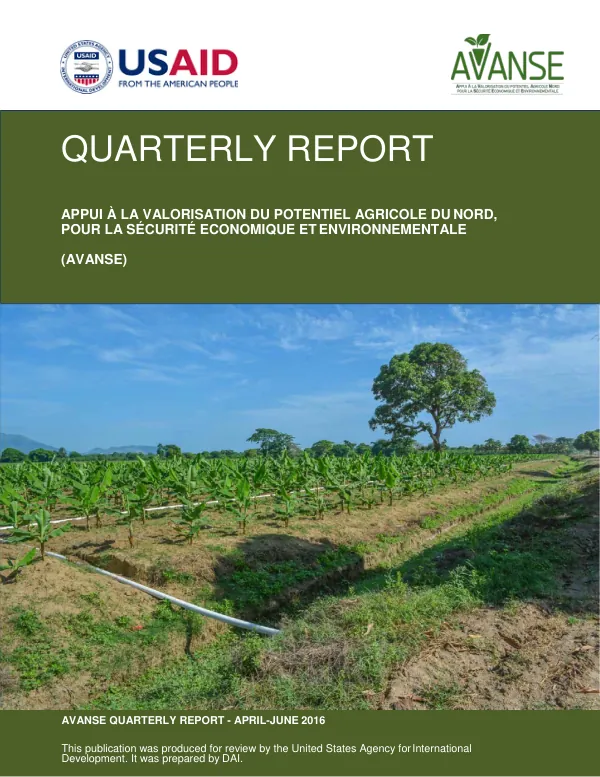
The rice team distributed 4,311 kg of rice seed for the summer campaign nurseries to 1,314 beneficiaries, of which 933 were new and 381 were continuing beneficiaries. The majority of these rice parcels have been geo-referenced, had their areas calculated, and entered into the AVANSE M&E system. Irrigation infrastructure and water user groups also made significant progress during the quarter. The AVANSE team worked with local communities to establish water user groups and improve irrigation infrastructure. This included the installation of pumps and the construction of canals, which enabled farmers to access water for their crops. Watershed stability above selected plains improved during the quarter. The AVANSE team worked with farmers to implement conservation agriculture practices, such as contour farming and terracing, which helped to reduce soil erosion and improve water retention. This resulted in improved watershed stability and reduced the risk of landslides and flooding. Agricultural markets were strengthened during the quarter, with improved access to storage and processing facilities, market information systems, and relationships in targeted value chains. The AVANSE team worked with farmers to establish market linkages and improve their access to markets, which resulted in increased sales and improved incomes. The AVANSE project also made progress in strengthening Haitian universities in the North. The project worked with the Université Roi Henri Christophe and the Université d'État d'Haïti, Limonade to establish a program of agricultural education and training. This included the development of a curriculum for agricultural education and the establishment of a program of short-term technical assistance for farmers. In addition, the project made progress in increasing access to inputs for farmers. The AVANSE team worked with local suppliers to establish a system of input delivery, which enabled farmers to access the inputs they needed to improve their productivity. This included the delivery of improved seeds, fertilizers, and other inputs. The project also made progress in stabilizing critical slopes through farmer-level investment. The AVANSE team worked with farmers to implement conservation agriculture practices, such as contour farming and terracing, which helped to reduce soil erosion and improve water retention. This resulted in improved watershed stability and reduced the risk of landslides and flooding. The AVANSE project also made progress in improving market information systems. The project worked with farmers to establish a system of market information, which enabled them to access information about market prices, demand, and supply. This resulted in improved decision-making and increased sales. The project also made progress in strengthening relationships in targeted value chains. The AVANSE team worked with farmers to establish relationships with buyers and other stakeholders in the value chain, which resulted in improved access to markets and increased sales. The AVANSE project also made progress in gender integration. The project worked with women farmers to establish a program of agricultural education and training, which included the development of a curriculum for women's agricultural education and the establishment of a program of short-term technical assistance for women farmers. In terms of monitoring and evaluation, the project made progress in establishing a system of monitoring and evaluation, which enabled the project team to track progress and identify areas for improvement. This included the development of a system of data collection and analysis, which enabled the project team to track progress and identify areas for improvement. The project also made progress in environmental compliance. The project worked with farmers to establish a system of environmental management, which included the implementation of conservation agriculture practices and the establishment of a system of environmental monitoring. Finally, the project made progress in project management. The project team worked to establish a system of project management, which included the development of a project plan, a budget, and a system of monitoring and evaluation. This enabled the project team to track progress and identify areas for improvement. Overall, the AVANSE project made significant progress during the third quarter of FY 2016, with improvements in agricultural production, irrigation infrastructure, watershed stability, agricultural markets, and gender integration. The project also made progress in monitoring and evaluation, environmental compliance, and project management.
Related documents