DAI
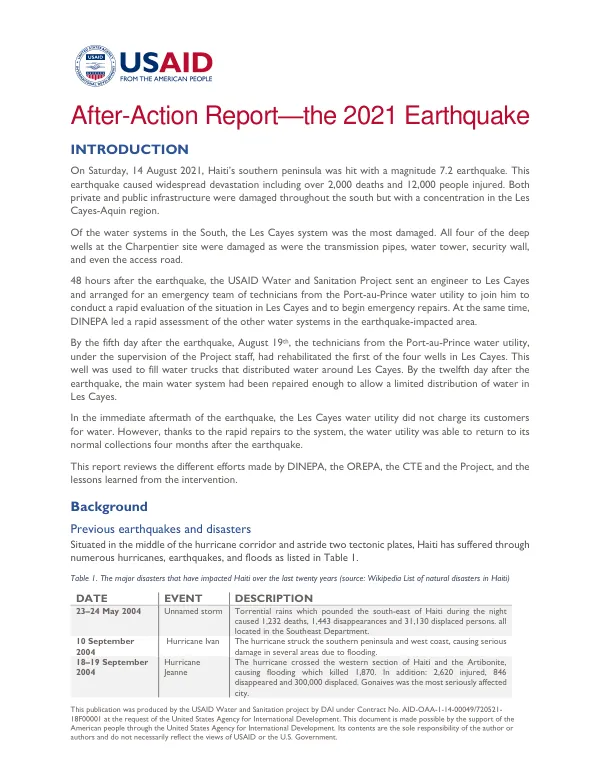
After-Action Report—the 2021 Earthquake
The August 14 Earthquake in Haiti's southern peninsula caused widespread devastation, resulting in over 2,000 deaths and 12,000 people injured.
2021 · 5 pages
Sign in to readA free account is required to download.
Abstract
The earthquake damaged both private and public infrastructure, with a concentration in the Les Cayes-Aquin region. The Les Cayes water system was severely impacted, with all four deep wells at the Charpentier site damaged, as well as the transmission pipes, water tower, security wall, and access road. A rapid evaluation of the situation in Les Cayes was conducted by a team of technicians from the Port-au-Prince water utility, under the supervision of the USAID Water and Sanitation Project staff. The team assessed the damage to the water systems in the earthquake-impacted area and began emergency repairs. By the fifth day after the earthquake, the first of the four wells in Les Cayes was rehabilitated, and water trucks were used to distribute water around Les Cayes. By the twelfth day after the earthquake, the main water system had been repaired enough to allow a limited distribution of water in Les Cayes. The Les Cayes water utility did not charge its customers for water in the immediate aftermath of the earthquake. However, thanks to the rapid repairs to the system, the water utility was able to return to its normal collections four months after the earthquake. The USAID Water and Sanitation Project's response to the earthquake focused on improving the long-term sustainability of the water systems, rather than providing emergency assistance. Haiti has a history of natural disasters, including hurricanes, earthquakes, and floods. The country is situated in the middle of the hurricane corridor and astride two tectonic plates, making it prone to these types of events. The August 14 Earthquake was the deadliest earthquake and deadliest natural disaster of 2021, and the worst disaster to strike Haiti since the 2010 earthquake. The economic loss from this earthquake was estimated at over 1.5 billion US dollars, nearly 10% of the country's annual gross domestic product. The USAID Water and Sanitation Project's activities in response to the earthquake included organizing a rapid evaluation of the situation in Les Cayes, compiling an overview of the impact of the earthquake on the Les Cayes system, and gathering information on the other water systems in the earthquake-impacted area. The team of technicians from the Port-au-Prince water utility worked together with the Project team to evaluate the power generation and water pumping, transmission, chlorination, and storage systems in Les Cayes. The main findings of the rapid evaluation included damage to the pump houses, transmission lines, and perimeter security fence, as well as turbid water from the wells. The team decided to focus first on clearing the water in the wells and repairing the transmission lines. By Thursday, August 18th, the water from the F2 well was no longer turbid, and an elevated piped connection was built from the well to outside the wellhouse. By Saturday, August 20th, three of the four wells were operational, and enough of the transmission lines were repaired that the CTE was able to begin testing water distribution in the area immediately around the wellfield.
Related documents