RAINFOREST ALLIANCE
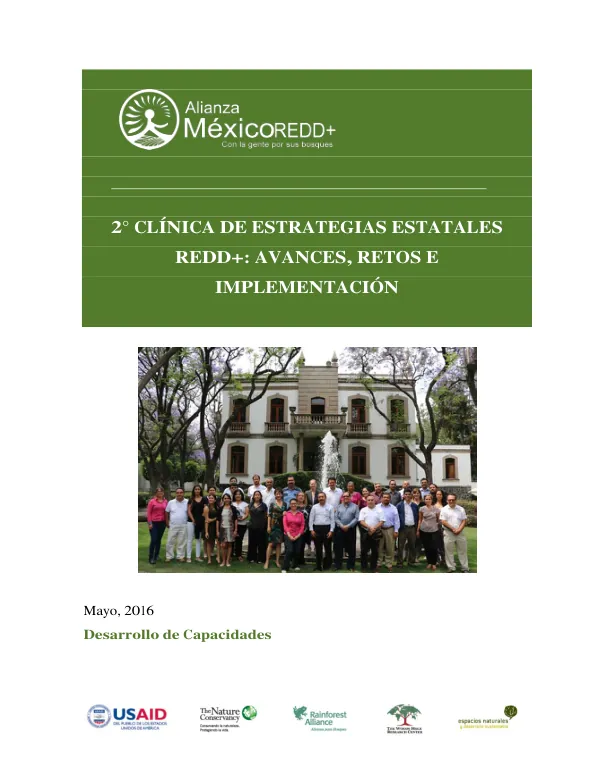
2° Clínica de Estrategias Estatales REDD+: Avances, Retos e Implementación
México's REDD+ initiative began in 2015, with the country presenting its proposal for Contributions to the Nationally Determined Contributions (INDC) to the United Nations Framework Convention on Climate Change (UNFCCC).
2016 · 39 pages
Sign in to readA free account is required to download.
Abstract
The proposal aimed to achieve a zero-deforestation rate by 2030. To achieve this goal, Mexico is in the process of constructing the REDD+ initiative, which seeks to reduce deforestation and degradation of forests and woods, thereby reducing greenhouse gas emissions due to the capture and storage of carbon dioxide, while also providing sustainable livelihoods compatible with social and cultural contexts. The country is currently developing its National REDD+ Strategy (ENAREDD+) and must construct those at the state level. Currently, five states are implementing early actions of REDD+ and two more states have joined, seeking to replicate successful experiences. These seven states are in the process of building the foundations that will allow the implementation of REDD+ at this scale. These states are Campeche, Chiapas, Jalisco, Quintana Roo, Yucatán, Chihuahua, and Oaxaca, with the latter two states seeking to replicate the process of constructing State REDD+ Strategies. The National REDD+ Strategy (ENAREDD+) was subject to public consultation between July 2015 and March 2016, with two approaches: public general and ejidos/communities/indigenous peoples. The consultation involved various channels, including virtual forums, presence-based workshops, and thematic workshops, as well as participation and consultation bodies, and reached a total of 54 states and 4 thematic workshops. The ENAREDD+ strategy aims to reduce deforestation and forest degradation, promote sustainable forest management, and conserve and restore forests. It also seeks to promote the participation of indigenous peoples and local communities in the decision-making process and to ensure that the benefits of REDD+ are shared equitably among all stakeholders. The strategy includes several key components, including the establishment of a national system for monitoring and reporting on forest carbon stocks, the development of a national forest inventory, and the creation of a national REDD+ fund. It also includes provisions for the protection of indigenous peoples' rights and the promotion of sustainable forest management practices. The implementation of the ENAREDD+ strategy will require the involvement of various stakeholders, including government agencies, civil society organizations, and the private sector. It will also require significant investment in capacity building, technology, and infrastructure. The states that are implementing early actions of REDD+ have made significant progress in developing their State REDD+ Strategies (EEREDD+). These strategies aim to reduce deforestation and forest degradation, promote sustainable forest management, and conserve and restore forests. They also seek to promote the participation of indigenous peoples and local communities in the decision-making process and to ensure that the benefits of REDD+ are shared equitably among all stakeholders. The EEREDD+ strategies include several key components, including the establishment of a state system for monitoring and reporting on forest carbon stocks, the development of a state forest inventory, and the creation of a state REDD+ fund. They also include provisions for the protection of indigenous peoples' rights and the promotion of sustainable forest management practices. The states that are implementing early actions of REDD+ have also made significant progress in developing their institutional capacity to implement REDD+. This includes the establishment of state-level REDD+ units, the development of state-level REDD+ policies and regulations, and the creation of state-level REDD+ funds. The states that are implementing early actions of REDD+ have also made significant progress in developing their monitoring and reporting systems for forest carbon stocks. This includes the establishment of state-level forest monitoring systems, the development of state-level forest inventory systems, and the creation of state-level REDD+ funds. The implementation of REDD+ at the state level will also require significant investment in technology and infrastructure, including the development of forest monitoring systems, the creation of REDD+ funds, and the establishment of state-level REDD+ units. The states that