USAID DEC
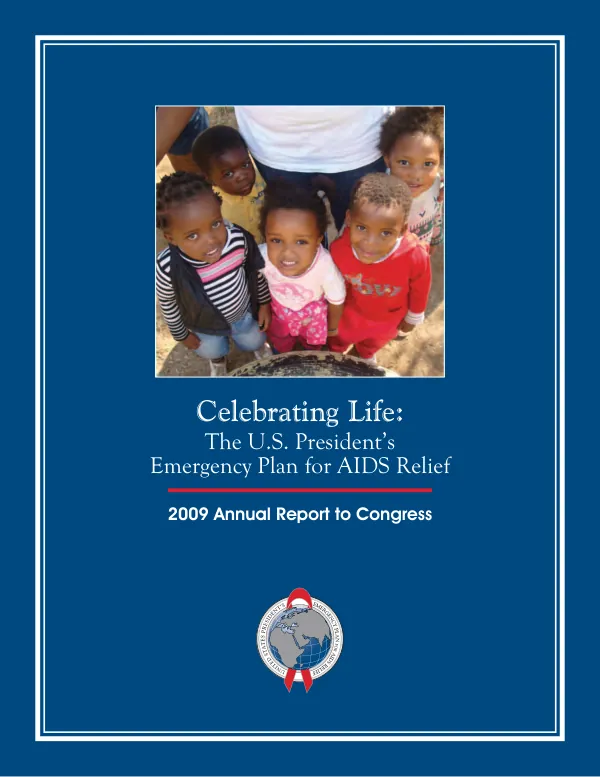
2009 Annual Report to Congress: Celebrating Life: The U.S. President’s Emergency Plan for AIDS Relief
Sign inINTERNATIONAL PEACE CORPS
2009 Annual Report to Congress: Celebrating Life: The U.S. President’s Emergency Plan for AIDS Relief
The U.S.
2009 · 64 pages
Sign in to readA free account is required to download.
Abstract
President's Emergency Plan for AIDS Relief (PEPFAR) was established in 2003 with an original commitment of $15 billion over 5 years. The initiative was the largest international health initiative in history dedicated to a single disease and the largest development initiative in the world. PEPFAR's first phase aimed to support prevention of 7 million new infections, treatment of 2 million, and care for 10 million, including orphans and vulnerable children. The initiative's scope was unprecedented, as it was the first large-scale effort to tackle a chronic disease in the developing world. PEPFAR moved beyond isolated efforts and pendulum swings that led programs to focus on prevention or treatment or care for HIV/AIDS, to sound public health principles - integrated prevention, treatment, and care. As of September 30, 2008, the American people had supported antiretroviral treatment (ART) for more than 2.1 million men, women, and children living with HIV/AIDS around the world. Of these, over 2 million people were reached through bilateral programs in PEPFAR's 15 focus countries in sub-Saharan Africa, Asia, and the Caribbean. PEPFAR treatment support was estimated to save 3.28 million adult years of life through September 2009, and many more beyond that time frame. In Tanzania, a young woman named Bertha gives back to her community and other people living with HIV/AIDS as a volunteer at Mawenzi Hospital. Bertha explains that she was diagnosed with HIV two years ago and was so sick that she believes she would have died without antiretroviral treatment. Now, she is healthy and strong, and can do anything. As of September 30, 2008, nearly 9.7 million people affected by HIV/AIDS in PEPFAR's focus countries had received some form of care, including prevention, treatment, and care services. This included over 2.1 million people receiving ART, more than 1.5 million people receiving prevention services, and over 5.5 million people receiving care services. The Soweto Hospice in Johannesburg, South Africa, was a hospice for the terminally ill, but following the introduction of life-saving antiretroviral treatment (ART) supported by PEPFAR, the hospice has been able to give HIV-positive patients a new lease on life. Patients who were once dying are now living, and the hospice has been able to provide a range of services, including ART, adherence support, and counseling. The Soweto Hospice has also established a pediatric unit to provide specialty care for children living with HIV/AIDS and other life-threatening diseases. This unit has improved the community's attitude towards HIV/AIDS, and has shown that HIV is no longer a death sentence. The hospice has turned World AIDS Day into a day to celebrate life, and has proven that the seemingly impossible is possible. In South Africa, the Soweto Hospice has become a model for other hospices, and has shown that with the right support and resources, people living with HIV/AIDS can lead healthy and productive lives. The hospice's success is a testament to the power of partnerships and the importance of integrated prevention, treatment, and care services.
Related documents