USAID DEC
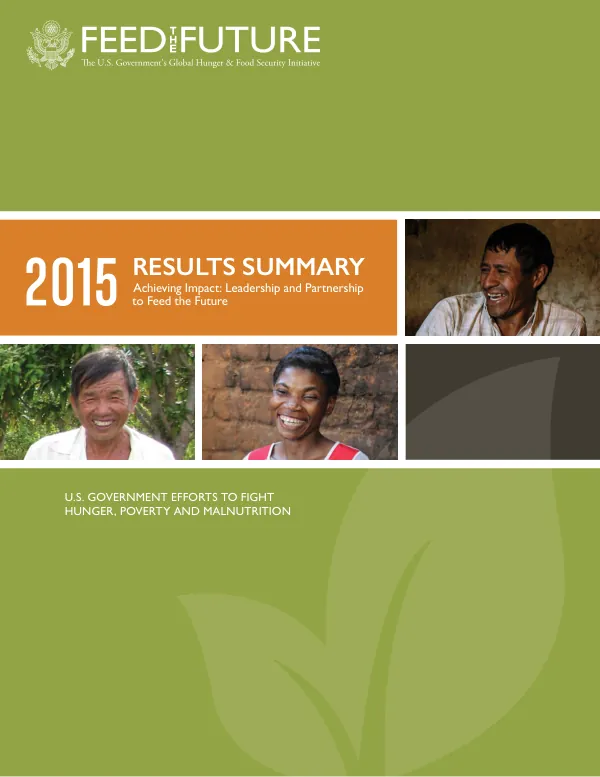
2015 Results Summary - Achieving Impact: Leadership and Partnership to Feed the Future
Sign inUSAID
2015 Results Summary - Achieving Impact: Leadership and Partnership to Feed the Future
Feed the Future, a U.S.
2015 · 24 pages
Sign in to readA free account is required to download.
Abstract
Government initiative, aims to reduce global hunger, food insecurity, and malnutrition. The initiative, launched by President Obama, focuses on building more productive, resilient agricultural systems through country ownership, accountability, and partnership. Feed the Future's public-sector investment and commitment to host-country leadership have contributed to meaningful progress against hunger, poverty, and malnutrition. The initiative reflects a coordinated U.S. Government focus on food security, poverty, and nutrition. Feed the Future incorporates agricultural production and markets, rural economic growth, institutional capacity building, land tenure security, nutrition promotion, gender, value chain development, trade, employment, and resilience programming. The initiative engages the private sector in a meaningful, comprehensive way to meet the global food security challenge. In countries supported by Feed the Future and other large-scale U.S. Government efforts, local capacity to support food security, agricultural productivity, and good nutrition continues to grow stronger. In 2014, Feed the Future-supported farmers experienced more than half a billion dollars in new agricultural sales, representing a 200 percent increase over the previous year. The number of individuals receiving agriculture and food security training through Feed the Future increased by 40 percent, new agriculture-related public-private partnerships increased by 90 percent, and the number of people trained to support child health and nutrition increased by 150 percent. Feed the Future has also reached more than 12 million children with nutrition interventions and helped nearly 7 million farmers gain access to new tools or technologies such as high-yielding seeds, fertilizer application, soil conservation, and water management. These increases represent the maturation and full mobilization of the initiative through its many partnerships with host-country governments, the private sector, the research community, and others. In Cambodia, where Feed the Future's array of partnerships have promoted nutrition, horticulture, vegetables, and other food security-related work for more than 4 years, child stunting has decreased by 21 percent in Feed the Future's zones of influence. Cambodian fish farmer Thai Meng is helping contribute to this progress. He smiles as he looks at his fish hatchery, which he began raising young fish to sell in the local market after a Feed the Future project introduced him to simple and cost-effective technologies to help improve hatcheries. New data indicate that the successes realized by individual farmers and communities reached by Feed the Future and other U.S. Government-led efforts are contributing to impacts in stunting and poverty. Bangladesh has seen considerable reductions in both poverty and child stunting over the past 3 years in the areas where Feed the Future works, and in Ethiopia, U.S. Government food security efforts contributed to a 9 percent reduction in stunting over the past 3 years. Stunting has declined by 33 percent nationwide in Ghana in recent years. In Honduras, average incomes of Feed the Future beneficiaries increased 55 percent between 2012 and 2014, which helped 36,000 extremely poor Feed the Future beneficiaries rise above the extreme poverty threshold. Feed the Future's successes are contributing to a broader impact, helping farmers, businesses, policymakers, and others to create better policy environments so that farm innovations and investments can extend to create off-farm jobs, increase production, and open new markets. The initiative is promoting improved policies to facilitate expanded private-sector contributions to ending hunger and poverty, a critical ingredient for long-term success.
Related documents