ICF
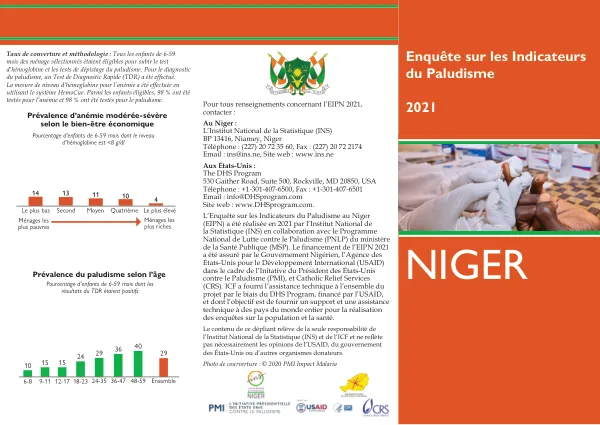
2021 Enquête sur les Indicateurs du Paludisme au Niger - Infographic
The L'Enquête sur les Indicateurs du Paludisme au Niger (EIPN) 2021 provides information on malaria in Niger.
2021 · 1 pages
Sign in to readA free account is required to download.
Abstract
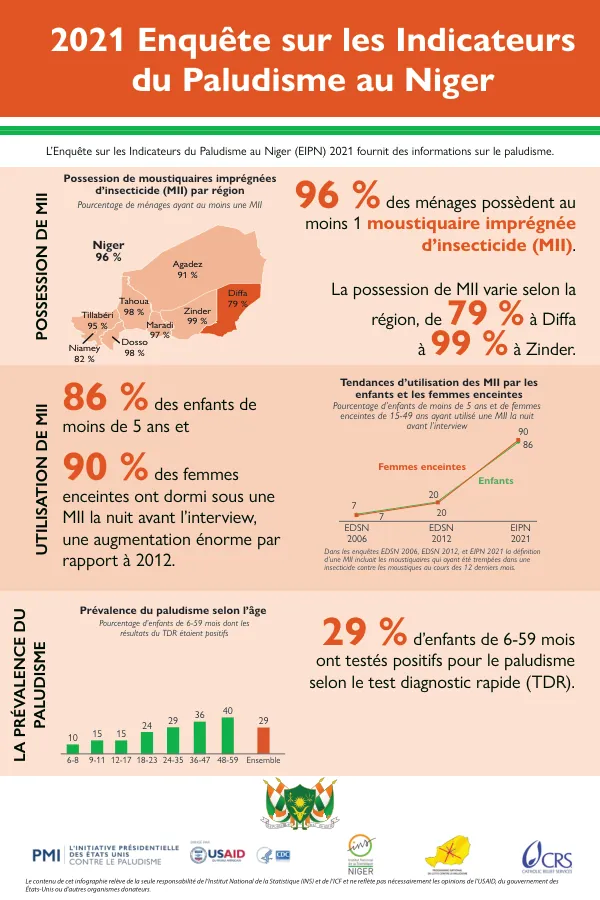
Twenty-nine percent of children aged 6-59 months tested positive for malaria according to the rapid diagnostic test (TDR). Ninety-six percent of households possess at least one insecticide-treated mosquito net (MII). MII possession varies by region, ranging from 79% in Diffa to 99% in Zinder. Eighty-six percent of children under 5 years and 90% of pregnant women slept under a MII the night before the interview, a significant increase compared to 2012. The use of MII has shown substantial growth over the years. The possession of MII by region is as follows: Agadez (91%), Diffa (79%), Dosso (98%), Maradi (97%), Niamey (82%), Tahoua (98%), Tillabéri (95%), Zinder (99%), and Niger (96%). Trends in MII usage among children and pregnant women are also observed, with 7% of children under 5 years and 20% of pregnant women using a MII the night before the interview in 2006, increasing to 20% and 90% respectively in 2012, and further increasing to 86% and 90% in 2021. The prevalence of malaria according to age is as follows: 6-8 months (10%), 9-11 months (15%), 12-17 months (24%), 18-23 months (29%), 24-35 months (36%), 36-47 months (36%), 48-59 months (29%), and 60-59 months (36%). The data indicates a significant increase in the use of MII among children and pregnant women over the years, suggesting a positive trend in malaria prevention efforts in Niger.
Connected topics