CHEMONICS
3 Year 5 Annual Work Plan for Lebanon Community Support Program
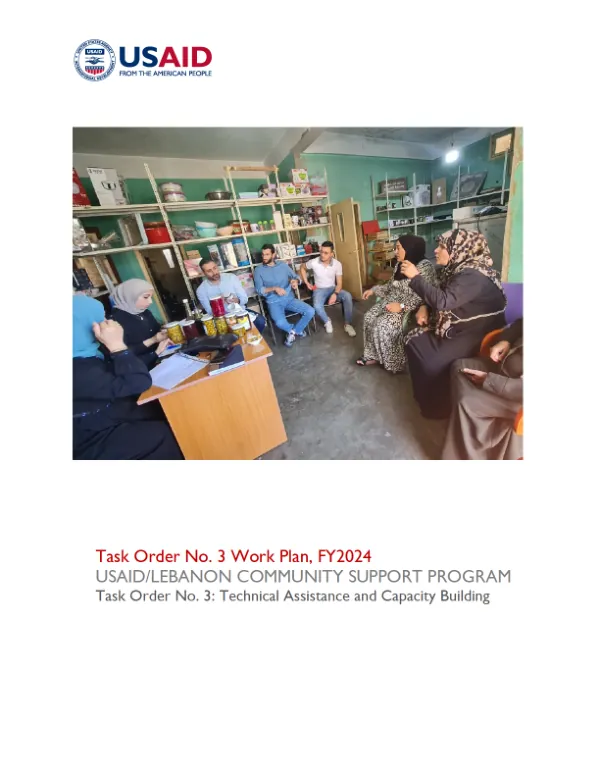
The Community Support Program (CSP) in Lebanon, Task Order 3 (TO3), aims to provide technical assistance and capacity building to municipalities and civil society organizations.
2024 · 40 pages
Sign in to readA free account is required to download.
Abstract
The program's objectives are to improve the capacity of local governments and civil society organizations to deliver essential services, promote economic growth, and enhance the overall well-being of the Lebanese population. The socio-economic context in Lebanon continued to deteriorate during the fourth year of TO3, with poverty levels remaining at around 74% and the Lebanese pound losing more than 90% of its value. Price inflation exceeded 254% in June 2023, and the GDP growth rate was estimated to be around 3% for 2023. These challenges severely affected TO3's working environment and operational assumptions, with municipalities and regional water establishments facing financial struggles and employees facing prohibitive transportation costs. To address these challenges, TO3 implemented several interventions, including the design and implementation of new Technical Assistance Assessment Reports (TAARs) and the continuation of existing TAARs. The program also focused on sustaining communities of practice on recyclables waste management, generator management, and cooperative sales and marketing. Additionally, TO3 improved sustainability through public-public partnerships and diaspora support schemes, and implemented cash-for-work programs for displaced individuals. The expected results of TO3's interventions include improved capacity of local governments and civil society organizations, enhanced economic growth, and improved overall well-being of the Lebanese population. The required resources for TO3's interventions include personnel, equipment, and funding, which will be allocated based on the program's work plan and budget. Task A of TO3 focuses on providing technical assistance to municipalities and civil society organizations. Sub-task A.1 involves designing at least two new TAARs and continuing the implementation of 37 USAID-approved TAARs. Sub-task A.2 involves sustaining communities of practice on recyclables waste management, generator management, and cooperative sales and marketing. Sub-task A.3 involves improving sustainability through public-public partnerships and diaspora support schemes. Sub-task A.4 involves implementing cash-for-work programs for displaced individuals. Task B of TO3 involves supporting Task Order 2 (TO2) in designing and implementing conflict and violence prevention activities. Task C involves partnering with the University Scholarship Program (USP) to recruit additional students and graduates into the CSP internship program. Task D involves developing an exit strategy for the CSP Knowledge Management Portal. The program's work plan is outlined in the Gantt chart annex, and the detailed annual budget is provided in Annex B. The program's acronyms are listed in Annex A. The program's objectives, interventions, and expected results are outlined in the introduction and subsequent sections of the document.
Related documents