USAID DEC
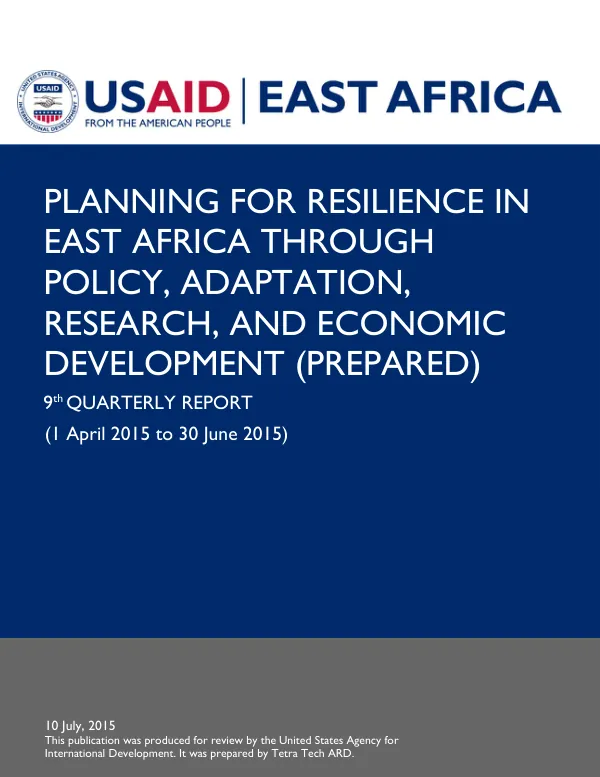
9th Quarterly Report: Planning for Resilience in East Africa through Policy, Adaptation, Research, and Economic Development (PREPARED)
Sign inTETRA TECH ARD, INC.
9th Quarterly Report: Planning for Resilience in East Africa through Policy, Adaptation, Research, and Economic Development (PREPARED)
The Planning for Resilience in East Africa through Policy, Adaptation, Research, and Economic Development (PREPARED) Program is a five-year, multi-organization comprehensive program aimed at mainstreaming climate-resilient development planning and program implementation into the East African Community (EAC) and its Partner States' development agendas.
2015 · 43 pages
Sign in to readA free account is required to download.
Abstract
The program is funded by the U.S. Agency for International Development's East Africa Regional Mission (USAID/East Africa—USAID/EA). The overall goal of the PREPARED Project, a component of the larger PREPARED Program, is to strengthen the resiliency and sustainability of East African economies, trans-boundary freshwater ecosystems, and communities. The PREPARED Project targets three key development challenges of the EAC region: transboundary freshwater biodiversity conservation; improved access to drinking water supply and sanitation services; and increased resiliency to climate change. During the reporting period, considerable progress was made in the implementation of Project components. Component 1: Climate change adaptation technical capacity, policy leadership, and response of regional institutions improved. The Project conducted the Climate Information Network (CIN) Strategic Action Planning Workshop (SAPW), where participants developed priority action plans to operationalize the CIN. The Climate Change Technical Working Group (CCTWG) meeting was held directly after the CIN SAPW, and the five Vulnerability Index (VI) assessments were completed for the Lake Victoria Basin (LVB), Mara River Basin (MRB), and other trans-boundary freshwater ecosystems. Component 2: Resilient and sustainable management of biologically significant trans-boundary freshwater ecosystems in the EAC region strengthened. The Project supported the development of the EAC Regional Biodiversity Conservation Strategy, which aims to conserve and manage the region's biodiversity. The Project also facilitated the establishment of the Biodiversity Task Force (BTF) to coordinate biodiversity conservation efforts in the region. Component 3: Resilient and sustainable water supply, sanitation, and wastewater treatment services in the Lake Victoria Basin enhanced. The Project supported the development of the Lake Victoria Basin Commission's (LVBC) Water Supply, Sanitation, and Hygiene (WASH) strategy, which aims to improve access to safe drinking water and sanitation services in the region. The Project also facilitated the implementation of the LVBC's WASH program, which includes the construction of new water supply systems and the rehabilitation of existing ones. Cross-cutting activities included the development of the PREPARED Program's Performance Management Plan (PMP), which outlines the program's performance indicators and targets. The Project also conducted a review of the program's progress and identified areas for improvement. Administrative achievements included the completion of the Project's quarterly report, which summarizes the program's progress and achievements during the reporting period. The Project also conducted a review of its administrative systems and identified areas for improvement. Deliverables included the completion of the CIN SAPW report, the CCTWG meeting minutes, and the five VI assessments. The Project also developed a work plan for the next quarter, which outlines the program's objectives, activities, and timelines. The PREPARED Project's progress is presented in greater detail in Section II (Key Achievements). The Project's performance monitoring and evaluation framework is outlined in Section IV (Performance Monitoring). The Project's links to other USAID programs are presented in Section V (Progress on Links to Other USAID Programs). The Project's sustainability and exit strategy are outlined in Section VII (Sustainability and Exit Strategy).