USAID DEC
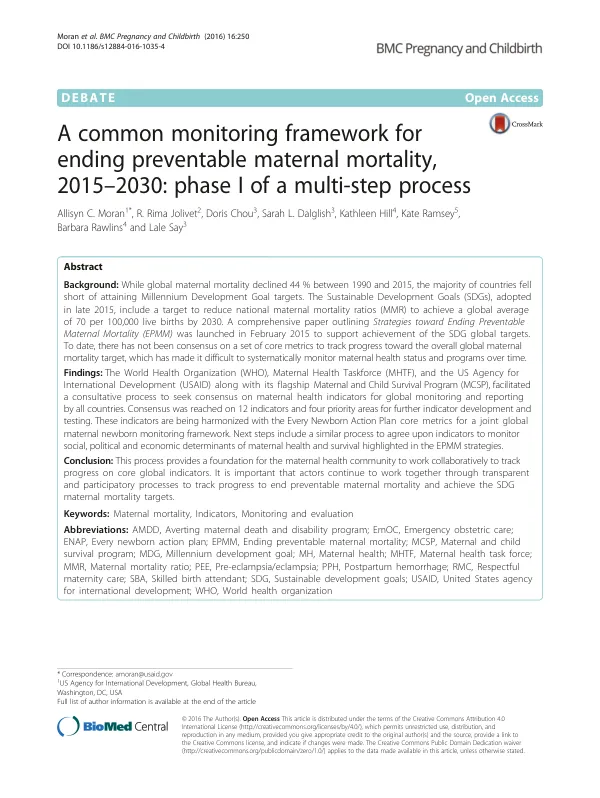
A common monitoring framework for ending preventable maternal mortality, 2015–2030: phase I of a multi-step process
Sign inUSAID
A common monitoring framework for ending preventable maternal mortality, 2015–2030: phase I of a multi-step process
The Ending Preventable Maternal Mortality (EPMM) initiative was launched in January 2013 by the World Health Organization (WHO) with support from partner organizations.
2016 · 13 pages
Sign in to readA free account is required to download.
Abstract
The initiative aimed to achieve multi-stakeholder consensus on goals for maternal health and survival from 2015 to 2030. The EPMM targets for maternal mortality reduction at the global and country levels include reducing the global average maternal mortality ratio (MMR) to less than 70 maternal deaths per 100,000 live births by 2030, and reducing each country's MMR by at least two thirds from the 2010 baseline. A comprehensive paper outlining the Strategies toward Ending Preventable Maternal Mortality (EPMM) was released by WHO in February 2015. This was followed by a synthesis of priorities for ending preventable maternal and newborn deaths and stillbirths in a series of technical papers in support of the updated United Nations Global Strategy for Women's, Children's, and Adolescent's Health (2016-2030). The EPMM global MMR target was incorporated into the Sustainable Development Goals (SDGs) adopted by member states and launched in late 2015. The EPMM global target was also included in the updated UN Global Strategy. To achieve the ambitious SDG and Global Strategy MMR targets, it will be imperative to accelerate coverage of quality essential services and to address the underlying social, political, and economic determinants of maternal health across all settings. To support implementation of EPMM strategies and to track progress toward global and country MMR targets, consensus on priority, methodologically robust maternal health (MH) indicators is urgently needed. The World Health Organization, Maternal Health Taskforce (MHTF), and the US Agency for International Development (USAID) along with its flagship Maternal and Child Survival Program (MCSP), facilitated an iterative consultative process to reach consensus on a core set of maternal health indicators for global monitoring and reporting under Phase I on behalf of the EPMM Working Group. The process included structured mapping exercises, development of key principles and criteria, selection of experts and stakeholders, facilitation of virtual consultations, and an in-person technical meeting to reach consensus on a core set of MH indicators for global monitoring. The EPMM-designated steering committee identified four principles to guide development and prioritization of a set of core MH indicators for global monitoring and reporting. The scope was limited to priority indicators appropriate for global monitoring and reporting by all countries, with no more than 10 to 12 indicators in total. The primary purpose of the indicators would be to track progress toward maternal mortality reduction at the global level. The steering committee also acknowledged that complementary indicators would be needed to support effective program management at sub-national and service delivery levels, but these indicators were beyond the scope of the EPMM global indicator exercise. A core set of 12 maternal health indicators was agreed upon through the consultative process. These indicators are being harmonized with the Every Newborn Action Plan (ENAP) core metrics to create a joint global maternal and newborn monitoring framework. The next steps include a similar process to agree upon indicators to monitor social, political, and economic determinants of maternal health and survival highlighted in the global EPMM strategy for testing by countries as part of national health plans and monitoring frameworks.
Related documents