USAID DEC
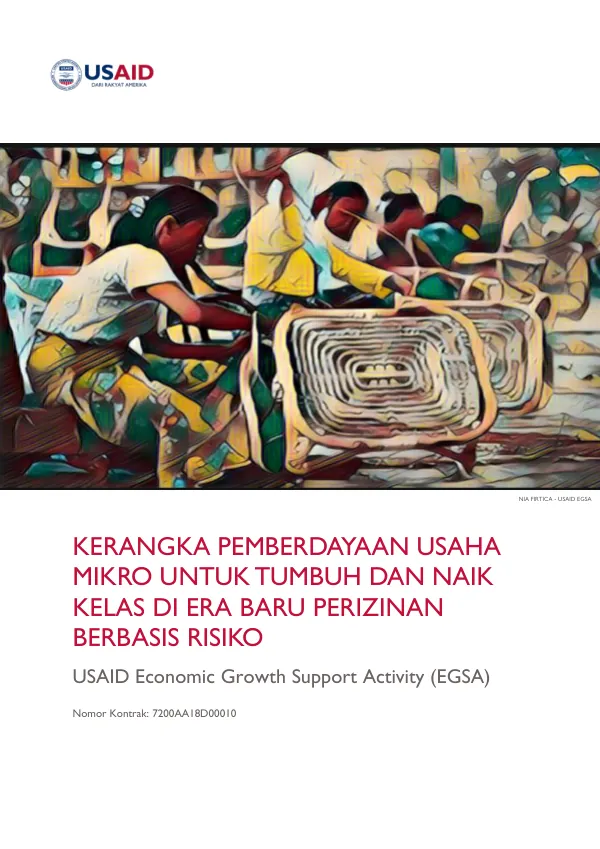
A FRAMEWORK FOR MICRO BUSINESS EMPOWERMENT TO SCALE UP IN THE NEW ERA OF RISK-BASED LICENSING
Sign inDEVTECH SYSTEMS, INC.
A FRAMEWORK FOR MICRO BUSINESS EMPOWERMENT TO SCALE UP IN THE NEW ERA OF RISK-BASED LICENSING
In Indonesia, the missing middle phenomenon has overshadowed the structure of Medium, Small and Micro Entrepreneurs (MSMEs) for more than a decade.
2021 · 94 pages
Sign in to readA free account is required to download.
Abstract
The Indonesian economy operates at a less than optimal level as the number of Micro Enterprises accounts for 99.6% of the total businesses, amounting to around 64 million businesses in the country. Despite having high resilience, micro-enterprises in Indonesia operate at a low level of productivity, as indicated by the average Gross Domestic Product growth which is lower than the national economic growth (2011-2018). The Indonesian government has enacted Government Regulation No. 5/2021, transforming the business licensing regime towards a Risk-Based Approach, which simplifies registration and licensing for micro and small businesses. This regulation is one of the derivative regulations of the Omnibus Law or the Job Creation Law, which was promulgated in 2020 (Law No. 11/2020). The effectiveness of various Micro and Small Business Empowerment programs must be optimized to maintain and increase this momentum. A study on Micro Business Empowerment to Scale Up in the New Era of Risk-Based Licensing was conducted by USAID EGSA, in collaboration with the Ministry of Cooperatives and SMEs, the National Planning and Development Agency (Bappenas), and other relevant government and regional agencies. The study utilized a design thinking approach to find relevant empowerment strategies to support Micro and Small Enterprises and help them scale up. The study analyzed good practices in micro-enterprise assistance programs carried out by the provinces of East Java and South Sulawesi, and/or local governments (districts/cities). The study found that any future MSME assistance program would be difficult to scale up without constructive improvements in the MSME database system. Therefore, the study divided the scope of the evaluation into two main topics: the design of the MSME national database system and the concept design of the MSME assistance program. Respondents suggested additional variables that need to be included in the database structure. The study also identified that there is no MSME database structure and system that provides data that is accurate, up-to-date, integrated, accountable, and easily accessible and shared between central and regional agencies. The study explored the programs that have had the most impact on businesses according to informants' perceptions. It was found that digital marketing training was the capacity building program that had the most impact on businesses. Other trainings that are considered to have a major impact on businesses sequentially are marketing management training, branding training, photography training, simple finance training, entrepreneurship training, product and production process development, and Human Resources (HR) management training. The marketing access program to identify market access for businesses had the most impact according to the informants' perception. This program is the most preferred by businesses as it allows direct sales transactions to occur. In addition, other marketing access programs that are considered to have the most impact are exhibitions/bazaars, business matching, and marketing of regional superior products at certain events. In the access to capital program, facilitating MSMEs to obtain funding from banks is considered the most impactful program for business development. A number of banks provide low-interest capital programs for businesses seeking funding for productive activities. Facilitating credit transactions between businesses who have never received a loan and banks is considered to have a significant impact on business development. Another access to capital program that is also considered to have an impact is the facilitation of funding with non-banking institutions to obtain funds for Small Business Development and Environmental Empowerment. This program is considered to have a significant impact in helping MSMEs as it provides access to funding with a relatively low interest rate. Another capital access program that is considered to have the most impact is the facilitation of MSME grants by providing business capital grants and purchasing production equipment. There are also impactful programs related to business legality, such as assisting MSMEs to register for permits. This program is considered to have a significant impact on business development as it helps MSMEs to obtain legality. The assistance provided involves obtaining a Business Identification Number (NIB) and a Small Micro Business Permit (IUMK). However, in the future, the IUMK will no longer be valid because there is an NIB, therefore legal registration assistance will be directed to obtain an NIB. In addition, other legality programs that are considered quite significant for businesses are Home Industry Products (PIRT) training, free permit services, and the issuance of land certificates. Ownership of legality is important to encourage MSMEs to scale up as it is a prerequisite for MSMEs to obtain operational permits and gain access to certain programs. Other programs that are considered to have a long-term impact on businesses include appropriate technology assistance, cluster development, and craft centers. These programs are considered impactful as
Related documents