CATHOLIC RELIEF SERVICES ORGANIZATION
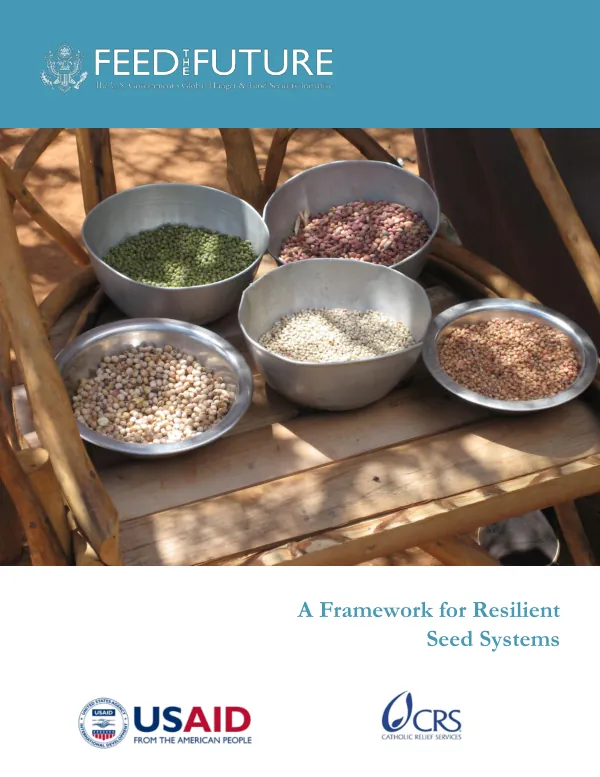
A Framework for Resilient Seed Systems
Seed system resilience is critical for ensuring seed security and, subsequently, food security in the face of climate change and other shocks and stressors.
2023 · 29 pages
Sign in to readA free account is required to download.
Abstract
The concept of resilience is defined by USAID as the ability of people, households, communities, countries, and systems to mitigate, adapt to, and recover from shocks and stresses in a manner that reduces chronic vulnerability and facilitates inclusive growth. A resilient seed system enables farmers to access appropriate seed for planting under changing conditions, such as those caused by climate change, environmental degradation, or protracted crisis. This system can withstand and/or adapt and recover from the effects of shocks and stressors, including climate-related events like droughts, floods, and cyclones, as well as economic shocks and conflict. The literature on resilience often refers to households or communities rather than systems. However, recent studies have explored the notion of resilience in relation to market systems and food systems. At a systems level, resilience has been defined as the capacity of the system to marshal and allocate available resources to respond to a shock or stress. Seed system resilience is defined as the ability of a seed system to maintain functionality and withstand, adapt, and recover from the effects of shocks and stressors in a manner that reduces chronic vulnerability and facilitates inclusive growth. The three key functions of a seed system are variety development and management, seed production, and seed dissemination. The market systems resilience framework developed by Downing et al. (2018) serves as a foundation for the framework presented here. This framework draws on existing frameworks and principles for seed system resilience, as summarized in Annexes 1-6. The framework is expected to be further developed and refined over time, and it can be considered as work in progress. A resilient seed system is essential for ensuring seed security and food security in the face of climate change and other shocks and stressors. The framework presented here aims to provide a comprehensive understanding of seed system resilience and its importance in the context of climate change and other challenges facing agricultural systems. The framework for seed system resilience is built on the concept of system behavior, which is influenced by various factors, including power dynamics, equity, and policy perspectives. The framework identifies three key characteristics of a resilient seed system: structural characteristics, behavioral characteristics, and information, trust, and innovation. Structural characteristics of a resilient seed system include the presence of a diverse range of seed varieties, a well-functioning seed supply chain, and adequate infrastructure for seed production and dissemination. Behavioral characteristics include the ability of farmers to adapt to changing conditions, the presence of a strong seed industry, and the ability of the seed system to respond to shocks and stressors. Information, trust, and innovation are critical components of a resilient seed system. This includes the availability of accurate and timely information on seed varieties, market trends, and climate-related risks, as well as the presence of trust among stakeholders, including farmers, seed producers, and buyers. Innovation is also essential for a resilient seed system, including the development of new seed varieties, technologies, and business models. The framework for seed system resilience identifies several types of interventions that can potentially build resilience into seed systems. These include the development of early generation seed (EGS) systems, the promotion of quality declared seed (QDS) systems, and the establishment of seed banks and gene banks. In conclusion, seed system resilience is critical for ensuring seed security and food security in the face of climate change and other shocks and stressors. The framework presented here provides a comprehensive understanding of seed system resilience and its importance in the context of climate change and other challenges facing agricultural systems.