GEORGETOWN UNIVERSITY
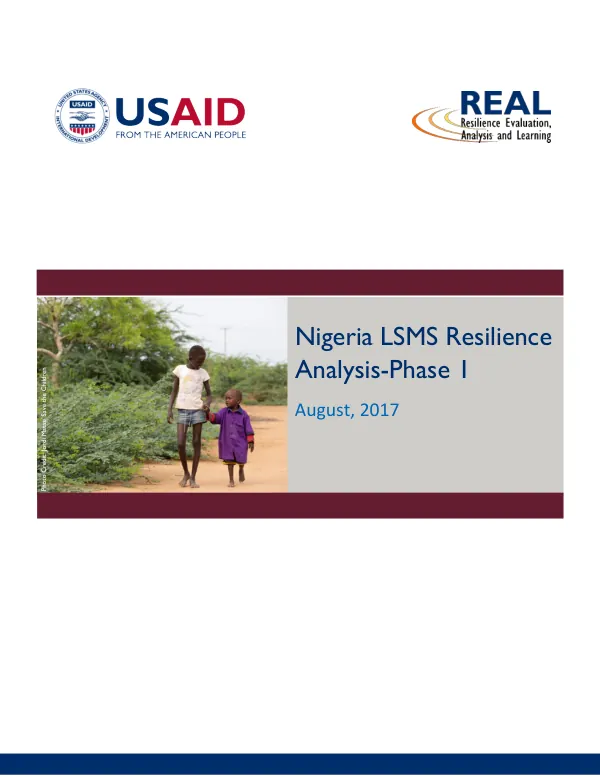
Nigeria Resilience Analysis Research Brief
Nigeria has emerged as Africa's largest economy, while remaining a cause for concern for humanitarian organizations.
2017 · 9 pages
Sign in to readA free account is required to download.
Abstract
Economic growth is inextricably linked to oil markets, which has been sluggish in recent years. The benefits of growth are not equitable either: in 2010, nearly two out of three Nigerians lived on less than $1.25 USD per day. Recurrent humanitarian crises and conflict in the Niger Delta and the North East continue to disrupt lives and livelihoods. In the North-East, Boko Haram has been responsible for the deaths of over 17,000 and displacement of 3.3 million people since 2009. Conflict poses a major threat to poverty alleviation and development by destroying infrastructure, markets, and contributing to deficiencies in economic and health status indicators. Building household and community resilience to conflict and other major shocks is critical for preserving development gains and ensuring sustainable long-term growth. Research has shown that conflict has deleterious effects on household hunger and child nutrition. A better enabling environment, including access to basic services and functions like village institutions, financial services, infrastructure, and electricity, reduces the impact of conflict on child nutrition. These same resilience capacities support household food security and consumption when they are confronted by other (primarily economic) shocks. Despite a proliferation of interventions and programs focused on building resilience, the concept of resilience to conflict shocks remains underexplored, with little evidence upon which to base investment and programming decisions. This analysis begins to address this evidence gap by re-analyzing available secondary data to study what household and community characteristics are important sources of resilience when confronted by conflict and other shocks. To answer this question, this analysis first assesses the impact of conflict shocks on key household welfare/well-being outcome indicators and analyzes the interactions between conflict and other shocks. Next, the role of various resilience capacities in mitigating the negative effects of conflict on household welfare is tested. The analysis concludes by exploring whether these capacities are unique for resilience to conflict or whether they also important resilience capacities for other shocks as well. The analysis draws from the World Bank Living Standards Measurement Study (LSMS) Nigeria General Household Survey. The LSMS provides a unique opportunity to study conflict and resilience dynamics because it is comprised of panel data collected in three waves from 2010-2016, coinciding with the rise of violence associated with Boko Haram. Using panel data like this enables analysis of trends over time to determine what characteristics are associated with improved wellbeing outcomes in the face of conflict. Constrained by the available data, the analysis focuses on absorptive and transformative capacities and three types of outcomes: child nutritional status, economic welfare, and food security. The analysis uses three estimation models for this analysis. The first is a difference-in-difference (DD) specification that compares changes from the baseline (2010) to the endline (2016), controlling for regional trends and household demographics. This specification describes the relationship between conflict (or other shocks) and a given wellbeing outcome (e.g. food security, child nutrition, economic status). The second specification is an extension of DD and is used to test the role of various resilience capacities in mitigating the negative effects of conflict on household welfare. The third specification is used to explore whether these capacities are unique for resilience to conflict or whether they also important resilience capacities for other shocks as well. The analysis finds that households with access to basic services and functions like village institutions, financial services, infrastructure, and electricity are more resilient to conflict shocks. These households also have better food security and consumption outcomes when confronted by other (primarily economic) shocks. The analysis also finds that households with higher levels of trust and risk aversion are more resilient to conflict shocks. These findings suggest that building household and community resilience to conflict and other major shocks requires a focus on strengthening absorptive and transformative capacities. The analysis concludes by highlighting the importance of understanding what makes households and communities resilient to conflict and other major shocks. This knowledge can inform the design of resilience-building investments that are responsive to these risks and can maximize impact among vulnerable populations. By building household and community resilience, development actors can help preserve development gains and ensure sustainable long-term growth in the face of conflict and other major shocks.