USAID DEC
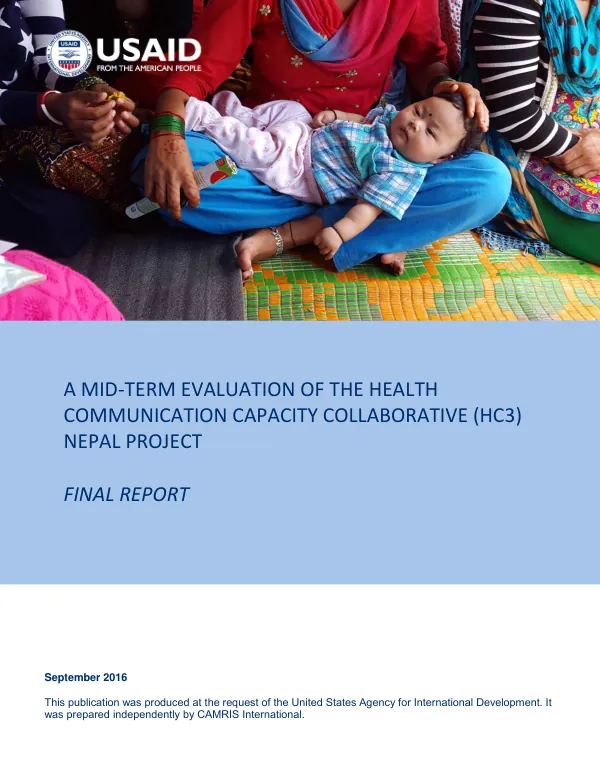
A MID-TERM EVALUATION OF THE HEALTH COMMUNICATION CAPACITY COLLABORATIVE (HC3) NEPAL PROJECT FINAL REPORT
Sign inHC3
A MID-TERM EVALUATION OF THE HEALTH COMMUNICATION CAPACITY COLLABORATIVE (HC3) NEPAL PROJECT FINAL REPORT
The Nepal Health Communication Capacity Collaborative (HC3) project is a comprehensive capacity-building initiative aimed at improving reproductive health outcomes in Nepal.
2016 · 145 pages
Sign in to readA free account is required to download.
Abstract
The project, launched in June 2014, is the principal USAID vehicle for building capacity within the Ministry of Health (MOH) to design and implement large-scale family planning Social and Behavior Change Communication (SBCC) programs in coordination with national partners. The HC3 Nepal project has been engaging with the National Health Education, Information and Communication Centre (NHEICC) and the family health division (FHD) in designing, implementing, and evaluating SBCC FP campaigns. The project's ultimate goal is to improve reproductive health outcomes in Nepal by developing the overall institutional and technical capacity of NHEICC and FHD to coordinate and implement evidence-based SBCC activities. In August 2015, the MOH, NHEICC, and FHD, with the support of USAID and HC3, launched a campaign entitled "Parivar niyojan, smart banchha jeewan," or "Family planning makes a smart life." The project has a national focus through its overarching mass media campaign targeting youth/young married couples and migrants, a district focus through community and facility-based interventions, and a geographically targeted component aimed at reaching distinct migrant groups and marginalized and disadvantaged groups. The evaluation team, comprising experts from CAMRIS International Inc. and the Nepal Monitoring, Evaluation, and Learning (MEL) Project, conducted a midterm evaluation of the HC3 Nepal project from July 11 to August 5, 2016. The evaluation aimed to assess the progress of the project, identify mid-course corrections, and provide recommendations for improvement. The evaluation team used a mixed-methods data collection approach, combining both quantitative and qualitative data collection methods. The team collected data from various sources, including surveys, focus group discussions, and interviews with project stakeholders, beneficiaries, and community members. The evaluation findings indicate that the HC3 Nepal project has made significant progress in achieving its objectives. The project's SBCC materials and activities have reached a substantial number of youth, migrants, and marginalized and disadvantaged groups, with a sufficient supply to meet demand. The project's capacity-building approaches have also contributed to improved capacity to coordinate, design, implement, monitor, and evaluate SBCC within the NHEICC and FHD and among USAID partners. The evaluation also highlights the project's success in generating and sharing evidence of effective SBCC practices with stakeholders. The project has developed a range of SBCC materials, including posters, billboards, and social media content, which have been widely disseminated and used by project stakeholders. However, the evaluation also identifies areas for improvement, including the need for more targeted and effective interventions to reach marginalized and disadvantaged groups. The evaluation recommends that the project focus on developing more tailored SBCC materials and activities that address the specific needs and concerns of these groups. Overall, the HC3 Nepal project has made significant progress in improving reproductive health outcomes in Nepal. The project's capacity-building approaches, SBCC materials, and activities have contributed to improved capacity to coordinate, design, implement, monitor, and evaluate SBCC within the NHEICC and FHD and among USAID partners. However, the project must continue to focus on addressing the specific needs and concerns of marginalized and disadvantaged groups to achieve its ultimate goal of improving reproductive health outcomes in Nepal.
Related documents