ICF
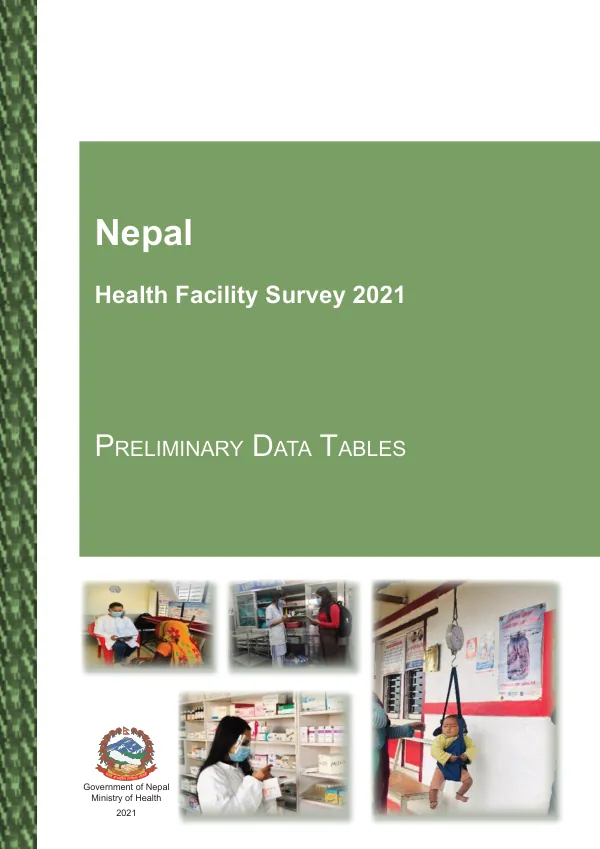
Nepal Health Facility Survey 2021 Preliminary Data Tables
The 2021 Nepal Health Facility Survey (NHFS) is a comprehensive sample survey of formal sector health facilities designed to provide information on the availability of essential health services in Nepal, the readiness of health facilities to provide those services, and the quality of client services.
2021 · 46 pages
Sign in to readA free account is required to download.
Abstract
The survey is the second of its kind, following the 2016 NHFS, and aims to track progress of the Nepal Health Sector Strategy (NHSS) 2016-2022 Results Framework. The survey assesses the overall availability of specific client services in Nepal health facilities, including general readiness of health facilities to provide client services, service-specific readiness of health facilities, quality of services, client perception, feedback, and accountability systems, and financial, inventory, and personnel management. The Ministry of Health and Population (MOHP) is leading the overall survey process, with a Technical Advisory Group and a Technical Working Group providing necessary oversight and technical input. The survey is funded by USAID, the British Embassy Kathmandu, and UNFPA, with field implementation managed by New ERA, a national research organization, and technical assistance provided by ICF based in the USA. The survey aims to build the survey capacity of Nepalese professionals in the government and private sector. The survey design involves a comprehensive sample of formal sector health facilities, with data collected on the availability of essential health services, readiness of health facilities, and quality of client services. The survey will provide high-quality data on service availability, readiness, and quality of care at health facilities, enabling the tracking of progress towards the NHSS 2016-2022 Results Framework. The survey will assess the availability of specific client services, including antenatal care, delivery services, newborn care, HIV testing and counseling, antiretroviral therapy, tuberculosis services, malaria services, and family planning services. The survey will also collect data on the availability of essential drugs, equipment, and supplies, as well as the quality of services, client perception, feedback, and accountability systems. The survey results will provide valuable insights into the availability and quality of health services in Nepal, enabling policymakers and stakeholders to make informed decisions to improve the health sector. The survey will also contribute to the development of evidence-based policies and programs to address the health needs of the Nepalese population. The survey data will be used to track progress towards the NHSS 2016-2022 Results Framework, which aims to improve the health sector in Nepal. The framework focuses on improving the availability and quality of health services, increasing access to health services, and strengthening the health system. The survey results will provide valuable information on the progress made towards achieving the framework's objectives. The survey will also contribute to the development of evidence-based policies and programs to address the health needs of the Nepalese population. The data collected will be used to identify areas of improvement, inform policy decisions, and develop targeted interventions to address the health needs of the population. The survey results will be disseminated to stakeholders, including policymakers, health professionals, and the general public, to raise awareness about the availability and quality of health services in Nepal. The survey will also contribute to the development of a culture of evidence-based decision-making in the health sector, enabling policymakers and stakeholders to make informed decisions to improve the health sector.
Related documents
![Changes in Service Availability, Readiness, Process of Care, and Client Satisfaction with Family Planning Services: A Comparison between the 2015 and 2021 Nepal Health Facility Surveys (FA147) - Analysis Brief [AB41]](https://covers.devme.ai/gen/138852.webp)