USAID DEC
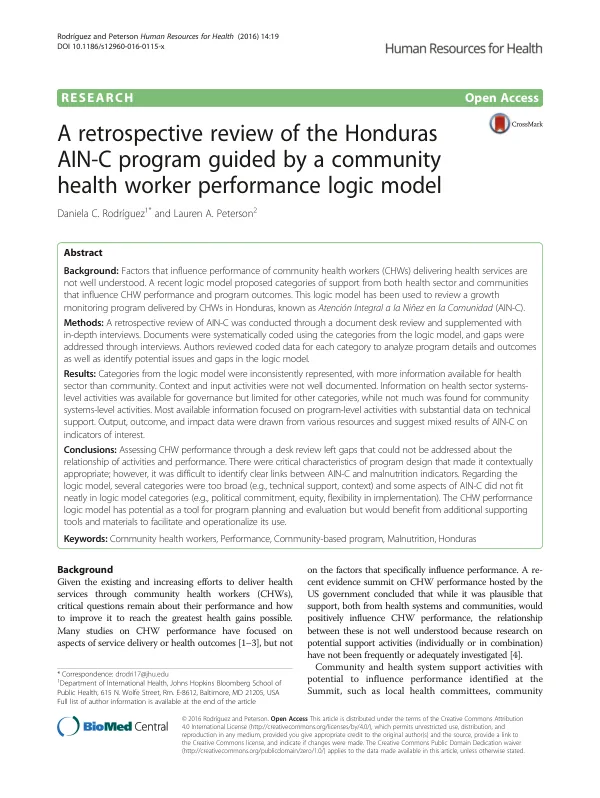
A retrospective review of the Honduras AIN-C program guided by a community health worker performance logic model
Sign inJOHNS HOPKINS UNIVERSITY BLOOMBERG SCHOOL OF PUBLIC HEALTH/INFO PROJECT
A retrospective review of the Honduras AIN-C program guided by a community health worker performance logic model
The community health worker performance logic model was developed to guide the assessment of factors influencing the performance of community health workers (CHWs) delivering health services.
2016 · 11 pages
Sign in to readA free account is required to download.
Abstract
The model proposes categories of support from both health sector and communities that influence CHW performance and program outcomes. A recent evidence summit on CHW performance concluded that while support from both sectors is plausible, the relationship between these factors is not well understood due to inadequate research on potential support activities. The AIN-C program in Honduras, a national community-based health and nutrition program focused on growth monitoring, was reviewed using the generic logic model for CHW performance. The program was developed in the late 1980s/early 1990s by the Ministry of Health in Honduras to address persistent malnutrition and static mortality rates. A community-based approach was piloted and determined to be the best way to reach rural families. The program was supported by volunteer CHWs known as monitoras who conducted community-based growth monitoring programs to detect faltering early and promote feeding strategies. Monitoras were selected by the community and provided monthly monitoring for children under two, followed up with households that missed monthly monitoring appointments, and provided counseling on child nutrition, care of common illnesses, and referrals to health center nurses. The program was designed to be flexible in implementation and allowed monitoras to hold growth monitoring sessions in the format most suitable to their community. The program also encouraged active community participation and evidence-based decisions. The AIN-C program was designed to roll out to 60 communities per year, with all communities covered nationwide within six years. Six disadvantaged departments were targeted, and the program was supported by USAID's BASICS program from 1995 through 2005. The program employed teams of monitoras to share responsibilities in each community, with at least one female member and one literate member required for the team to perform effectively. The monitoras provided monthly monitoring for children under two and followed up with households that missed monthly monitoring appointments. They also provided counseling on child nutrition, care of common illnesses, and referrals to health center nurses. The data collected were used by the monitoras to trigger dialogue with caregivers and inform individualized counseling, by the community to measure progress and identify impediments to growth, and by health system actors to measure outcomes and improve the program. The AIN-C program was designed to be flexible in implementation and allowed monitoras to hold growth monitoring sessions in the format most suitable to their community. The program also encouraged active community participation and evidence-based decisions. The program was supported by volunteer CHWs known as monitoras who conducted community-based growth monitoring programs to detect faltering early and promote feeding strategies. The AIN-C program was reviewed using the generic logic model for CHW performance, which proposes categories of support from both health sector and communities that influence CHW performance and program outcomes. The review found that the categories from the logic model were inconsistently represented, with more information available for health sector than community. Context and input activities were not well documented, and information on health sector systems-level activities was available for governance but limited for other categories.
Related documents