ABT ASSOCIATES
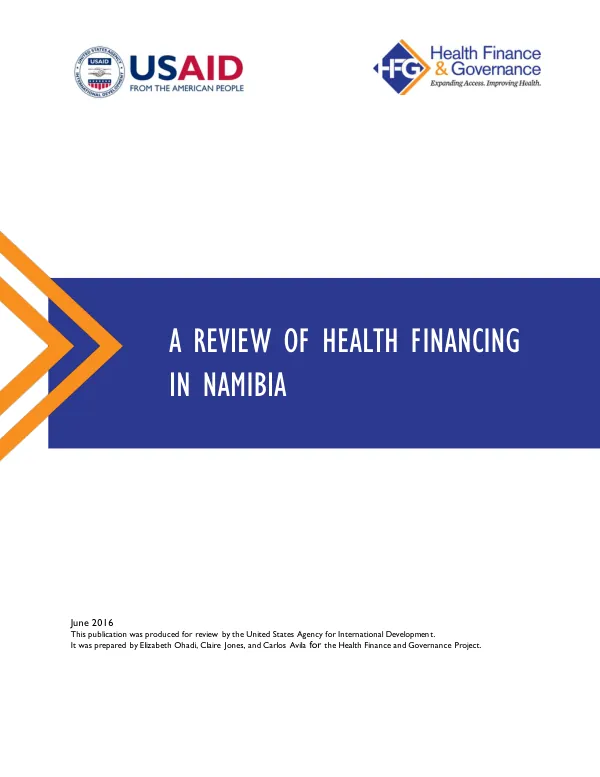
A Review of Health Financing in Namibia
The Health Finance and Governance Project, led by Abt Associates, aims to improve health in developing countries by expanding people's access to healthcare.
2016 · 94 pages
Sign in to readA free account is required to download.
Abstract
The project team works with partner countries to increase their domestic resources for health, manage those resources more effectively, and make wise purchasing decisions. As a result, this five-year, $209 million global project increases the use of both primary and priority health services, including HIV/AIDS, tuberculosis, malaria, and reproductive health services. The project's focus is on fundamentally strengthening health systems, supporting countries as they navigate economic transitions needed to achieve universal health care. In Namibia, the project's objectives are aligned with the country's efforts to achieve universal health coverage (UHC). The Namibian government has made significant progress in increasing access to healthcare services, but challenges remain in ensuring that the population has adequate financial protection against health expenditures. Namibia's health financing system is characterized by a mix of public and private sector financing. The government is the primary source of health financing, accounting for approximately 70% of total health expenditure. Private sector financing, including out-of-pocket payments and private prepaid plans, accounts for around 30% of total health expenditure. The government's health expenditure is primarily funded through general government revenue, with a significant portion coming from the Southern African Customs Union (SACU) revenue. The analysis of health financing arrangements in Namibia reveals several challenges. The country's health financing system is characterized by a high level of out-of-pocket payments, which can lead to financial hardship for households. The government's health expenditure is also concentrated in a few areas, such as curative care, leaving a gap in preventive and promotive services. Furthermore, the health financing system is not equitable, with the poor and vulnerable populations bearing a disproportionate burden of health expenditures. The analysis also highlights the importance of increasing domestic resources for health and improving the efficiency of health expenditure. The government's health expenditure is not aligned with the country's health needs, and there is a need to prioritize health spending in areas such as preventive and promotive services. The project recommends that the government increase its domestic resources for health through a combination of increased taxation and improved revenue collection. The government should also prioritize health spending in areas such as preventive and promotive services, and improve the efficiency of health expenditure through better planning and management. The project's recommendations are aligned with the country's efforts to achieve UHC. The government has made significant progress in increasing access to healthcare services, but challenges remain in ensuring that the population has adequate financial protection against health expenditures. The project's recommendations aim to address these challenges and support the government in achieving its UHC goals. The project's analysis of health financing arrangements in Namibia is based on a review of existing literature and data. The analysis highlights the importance of increasing domestic resources for health and improving the efficiency of health expenditure. The project's recommendations are aligned with the country's efforts to achieve UHC and aim to support the government in addressing the challenges in the health financing system. The project's findings and recommendations are presented in a series of tables and figures, which provide a detailed analysis of the health financing system in Namibia. The tables and figures present data on health expenditure, revenue collection, and health outcomes, providing a comprehensive picture of the health financing system in Namibia. The project's recommendations are based on a thorough analysis of the data and are aimed at supporting the government in achieving its UHC goals. The project's analysis of health financing arrangements in Namibia highlights the importance of increasing domestic resources for health and improving the efficiency of health expenditure. The project's recommendations are aligned with the country's efforts to achieve UHC and aim to support the government in addressing the challenges in the health financing system. The project's findings and recommendations are presented in a series of tables and figures, which provide a detailed analysis of the health financing system in Namibia.