USAID DEC
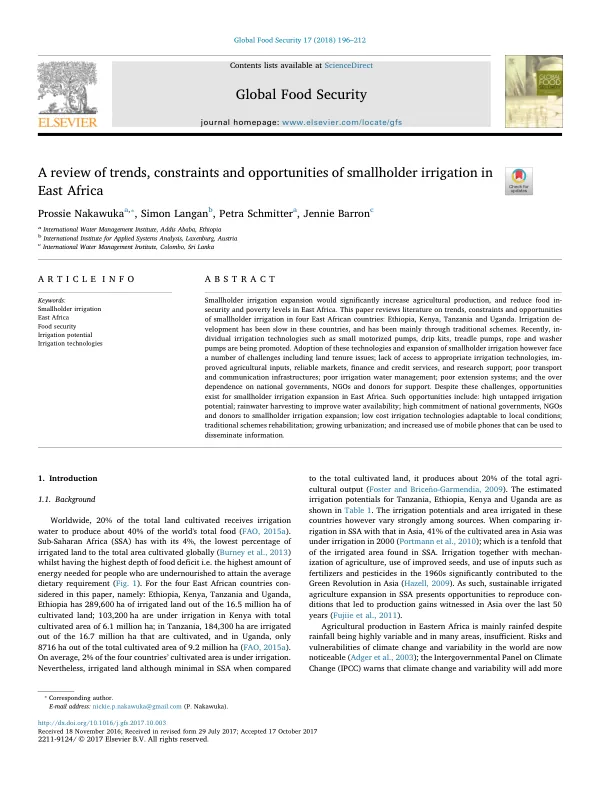
A review of trends, constraints and opportunities of smallholder irrigation in East Africa
Sign inFOOD AND AGRICULTURE ORGANIZATION OF THE UNITED NATIONS IN GEORGIA
A review of trends, constraints and opportunities of smallholder irrigation in East Africa
Smallholder irrigation expansion would significantly increase agricultural production, and reduce food insecurity and poverty levels in East Africa.
2018 · 17 pages
Sign in to readA free account is required to download.
Abstract
The four East African countries considered in this review are Ethiopia, Kenya, Tanzania, and Uganda. Irrigation development has been slow in these countries, and has been mainly through traditional schemes. Recently, individual irrigation technologies such as small motorized pumps, drip kits, treadle pumps, rope and washer pumps are being promoted. Adoption of these technologies and expansion of smallholder irrigation face a number of challenges including land tenure issues; lack of access to appropriate irrigation technologies, improved agricultural inputs, reliable markets, finance and credit services, and research support; poor transport and communication infrastructures; poor irrigation water management; poor extension systems; and the over dependence on national governments, NGOs and donors for support. Despite these challenges, opportunities exist for smallholder irrigation expansion in East Africa. Such opportunities include high untapped irrigation potential; rainwater harvesting to improve water availability; high commitment of national governments, NGOs and donors to smallholder irrigation expansion; low cost irrigation technologies adaptable to local conditions; traditional schemes rehabilitation; growing urbanization; and increased use of mobile phones that can be used to disseminate information. Worldwide, 20% of the total land cultivated receives irrigation water to produce about 40% of the world's total food. Sub-Saharan Africa has the lowest percentage of irrigated land to the total area cultivated globally, while having the highest depth of food deficit. For the four East African countries considered in this review, Ethiopia has 289,600 ha of irrigated land out of the 16.5 million ha of cultivated land; Kenya has 103,200 ha under irrigation out of the 6.1 million ha of cultivated land; Tanzania has 184,300 ha irrigated out of the 16.7 million ha of cultivated land; and Uganda has 8716 ha of irrigated land out of the 9.2 million ha of cultivated land. On average, 2% of the four countries' cultivated area is under irrigation. Irrigation together with mechanization of agriculture, use of improved seeds, and use of inputs such as fertilizers and pesticides in the 1960s significantly contributed to the Green Revolution in Asia. Sustainable irrigated agriculture expansion in SSA presents opportunities to reproduce conditions that led to production gains witnessed in Asia over the last 50 years. Agricultural production in Eastern Africa is mainly rainfed despite rainfall being highly variable and in many areas, insufficient. Risks and vulnerabilities of climate change and variability in the world are now noticeable, and the Intergovernmental Panel on Climate Change warns that climate change and variability will add more pressures on water availability, accessibility and demand in Africa. Smallholder farmers dominate agricultural production in Eastern Africa, and they face a number of challenges including unreliable rainfall, volatile food and energy prices, lack of access to technologies, inputs, markets and credit. These factors have contributed to the low agricultural productivity that is witnessed in most communities in East Africa. Increase in food production in sub-Saharan Africa in the past has been through increasing the area cultivated and using more labor. Due to current dense population patterns, cultivatable land is now scarce, and agricultural production thus needs to be intensified in order to increase yields that will ensure economic growth, food security and poverty reduction in especially the rural communities.
Related documents
Documents in this collection
 2014
2014USAID DEC
Feed the Future: Building Capacity for African Agricultural Transformation (Africa Lead II) Quarterly Report: April-June 2014
Open record 2012
2012USAID DEC
AgExchange #2: Best Practices, Lessons Learned, and Effective Tools in Knowledge Sharing for Food Security and Agriculture Programs
Open record