CATHOLIC RELIEF SERVICES ORGANIZATION
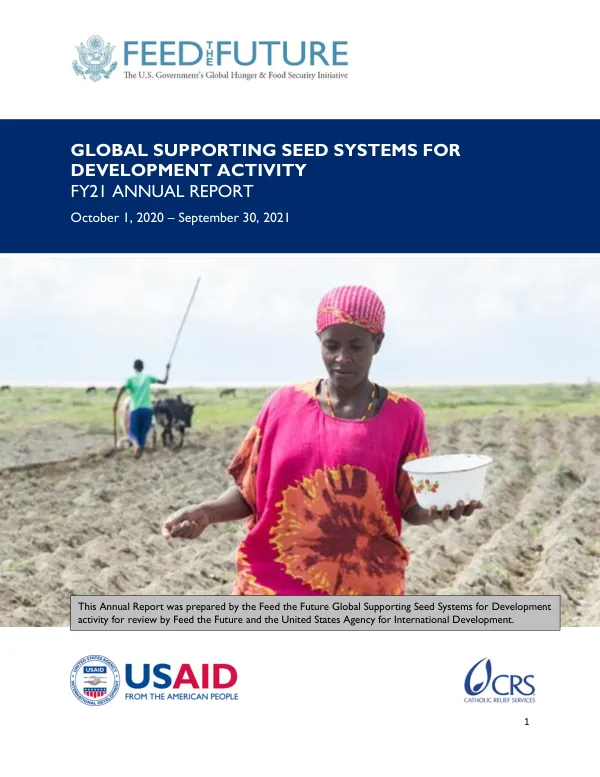
Global Supporting Seed Systems for Development Activity FY21 Annual Report
The Feed the Future Global Supporting Seed Systems for Development activity (S34D) is a five-year Leader with Associates Award, funded by Feed the Future Initiative through the Bureau for Resilience and Food Security (RFS) and by USAID through the Bureau for Humanitarian Assistance (BHA).
2021 · 78 pages
Sign in to readA free account is required to download.
Abstract
Catholic Relief Services (CRS) is leading this consortium with support from partners that include: Agri Experience (AE), the Alliance of Bioversity International and CIAT (the Alliance), Pan-African Bean Research Alliance (PABRA), and Opportunity International (OI). S34D's Life of Activity (LOA) runs from August 2018 through August 2023. The overarching goal of S34D is to improve the functioning of national seed sectors in focus countries in an inclusive manner. This 'inclusive' approach aims to support all farmers, including women farmers and youth. S34D aims to meet the activity goals by increasing the capacity of the formal and informal seed systems and humanitarian and relief programming to sustainably offer quality, affordable seeds of a range of crops (Objective 1) and increasing collaboration and coordination among all seed systems actors and actions (Objective 2). In FY21, S34D was able to reach many more participants than initially targeted, primarily due to several trainings that were conducted remotely due to the ongoing pandemic. Under the formal sector, S34D validated and completed the Uganda seed profile, continued working with the Seed Control and Certification Institute in Zambia on the e-learning training course for private and public seed inspectors. The institute trained 147 seed inspectors (35 women) from Zambia, Malawi, and Mozambique via Zoom, with 134 taking the exam and 113 passing (26 women). In the informal sector, the Alliance piloted the second season of the niche market business model, and CRS used the Point of Sales (PoS) survey to gauge variety performance and farmers' feedback on adoption of high-yielding varieties of bean in Kenya. The Alliance and PABRA, in collaboration with INERA, conducted an informal seed systems assessment in several countries, including Niger, Kenya, Uganda, Malawi, and Tanzania. This assessment aimed to understand the informal seed systems and identify opportunities for improvement. S34D also continued to work on cross-cutting initiatives, including the development of a seed voucher fair (SVF) system in Kenya. The SVF system aims to increase access to quality seeds for smallholder farmers by providing a platform for farmers to purchase seeds directly from certified seed suppliers. In FY21, the SVF system was piloted in several counties in Kenya, with over 1,000 farmers participating. In addition to these achievements, S34D also made progress on its humanitarian and relief programming. The activity worked with partners to develop a seed system security assessment (SSSA) tool, which aims to identify vulnerabilities in seed systems and provide recommendations for improvement. The SSSA tool was piloted in several countries, including Somalia and South Sudan. Overall, S34D made significant progress in FY21 towards its goals of improving the functioning of national seed sectors and increasing collaboration and coordination among all seed systems actors and actions. The activity continues to work towards its objectives, with a focus on building the resilience of seed systems and improving access to quality seeds for smallholder farmers.