GRAMEEN KRISHI FOUNDATION
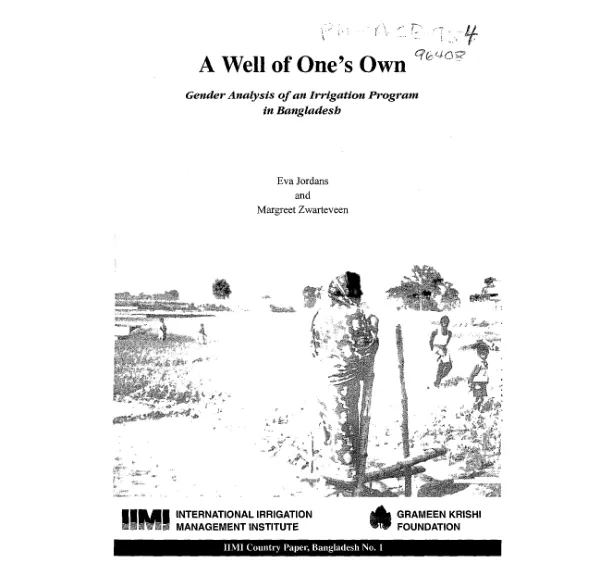
A well of one"s own : gender analysis of an irrigation program in Bangladesh
In North-West Bangladesh, the working area of the Grameen Krishi Foundation (GKF), women, especially the poorer ones targeted by GKF, carry out about 50% of all tasks in rice production, including the presumably male task of irrigation.
Jordans, Eva; Zwarteveen, Margaret · 1970
Sign in to readA free account is required to download.
Abstract
When GKF realized the potential of farming for increasing women"s income, it shifted its gender strategy in 1992 from developing specific activities for women to involving female farmers directly in its irrigation activities. The present study documents these efforts. GKF makes irrigation services available to women either in groups or as individuals. These services include access either to deep or shallow tube well irrigation water or to irrigation technology (shallow or hand tube wells, and treadle pumps). GKF also negotiates with landowners to secure land lease arrangements on behalf of women, and provides women seeds, fertilizer, agricultural credit, technical training, and marketing services. This strategy is gradually showing signs of success. Female involvement in GKF"s irrigation activities, almost nil in 1992, has increased dramatically. The study shows that women are very interested in and capable of managing irrigation equipment and irrigated crop production. The seasonal net income from irrigation ranges from Tk 1,000 to Tk 5,000 per woman, compared with the Tk 500 per season a woman would earn as a wage laborer. The increased income-generating capacity and larger contributions to household income appear to strengthen women"s self-confidence and reduce their dependence on male intermediaries. Negative social reactions are offset by the organization of the women into groups and strong support from GKF staff. The study also suggests that women"s control over household income increases when their contributions increase; this control could be increased further by the provision of direct marketing assistance and basic education in literacy and numeracy. Women also need longer-term access to land in order to optimize farm profits. Key elements of GKF"s success are its broad rural development approach, which combines the provision of irrigation with that of credit, agricultural inputs, marketing services, and information, and the fact that field staff are permanently based in the villages. The primary basis for GKF"s achievements in empowering women, however, lies in its remarkably serious commitment to women and its acceptance of women as farmers and irrigators. Without this recognition, any attempt to address gender issues in an irrigation program will have only marginal results. (Author abstract, modified)
![Business linkages and producer associations in Bangladesh : options for rural ME [micro-entrepreneurs] development](https://covers.devme.ai/gen/46813.webp)