USAID DEC
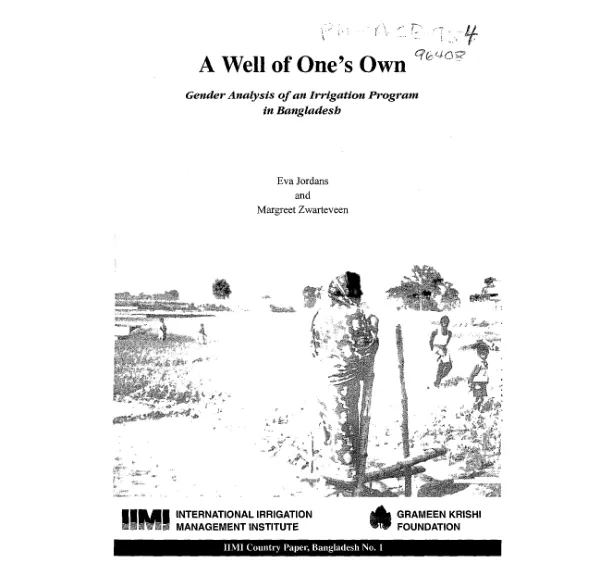
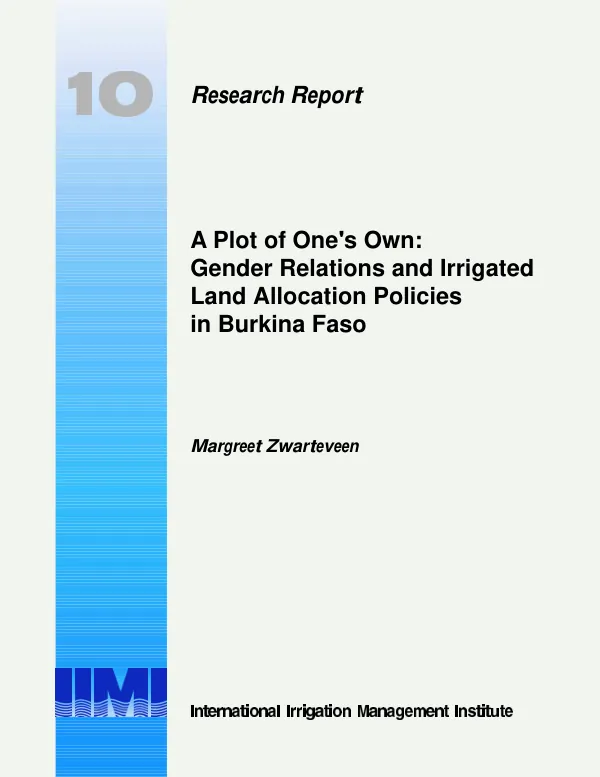
Plot of one"s own : gender relations and irrigated land allocation policies in Burkina Faso
Sign inINTERNATIONAL IRRIGATION MANAGEMENT INSTITUTE (IIMI)
Plot of one"s own : gender relations and irrigated land allocation policies in Burkina Faso
Even though a number of studies suggest that restricting the allocation of irrigated plots to men is one of the causes for the disappointing performance of irrigation projects in West Africa, Burkina Faso continues to restrict the allocation of plots to male-headed households.
Zwarteveen, Margaret · 1970
Sign in to readA free account is required to download.
Abstract
The Dakiri irrigation system is one of the few systems in that country where some women obtained irrigated plots on an individual basis; 60 women (or 9% of the total number of plot-holders) have individual plots. Most of their husbands also have plots. This report presents the findings of a case study carried out in the Dakiri irrigation system in 1995. The study explored the effects of the allocation of plots to both men and women by comparing the households in which only men are plot-holders with those in which both men and women have access to irrigated plots. This comparison was made with respect to (1) the agricultural productivity of irrigated plots, (2) the labor contributions of male and female household members to the different plots and fields, and (3) the intra-household distribution of agricultural incomes. Study findings show that the productivity of both irrigated land and labor is higher in households where both men and women have an irrigated plot each, in comparison with households in which only men have plots. Women are equally good as men or even better in irrigated farming, while their motivation to invest labor in irrigated production significantly increases when they have individual plots. Income of women increases sharply when they have their own irrigated plots, while the proportion of labor contributed by women to men"s plots is virtually the same. The increase in income obtained by having irrigated plots reduces women"s economic dependence on men and strengthens their bargaining position within the household. It is important to recognize that, in Dakiri, households where both men and women have plots have more irrigated land than households where only men have plots. The labor contribution (person-days per hectare) therefore decreases when there is more than one plot-holder per household. The evidence nevertheless suggests that allocating smaller plots separately to men and women, instead of allocating bigger plots to household heads, has positive production and social benefits. Includes references. (Author abstract, modified)
Related documents