LEVI STRAUSS FOUNDATION
AC Newsletter January - March 2016
The Arbitration Council (AC) in Cambodia has been actively involved in resolving collective labour disputes since its establishment in May 2003.
2016 · 8 pages
Sign in to readA free account is required to download.
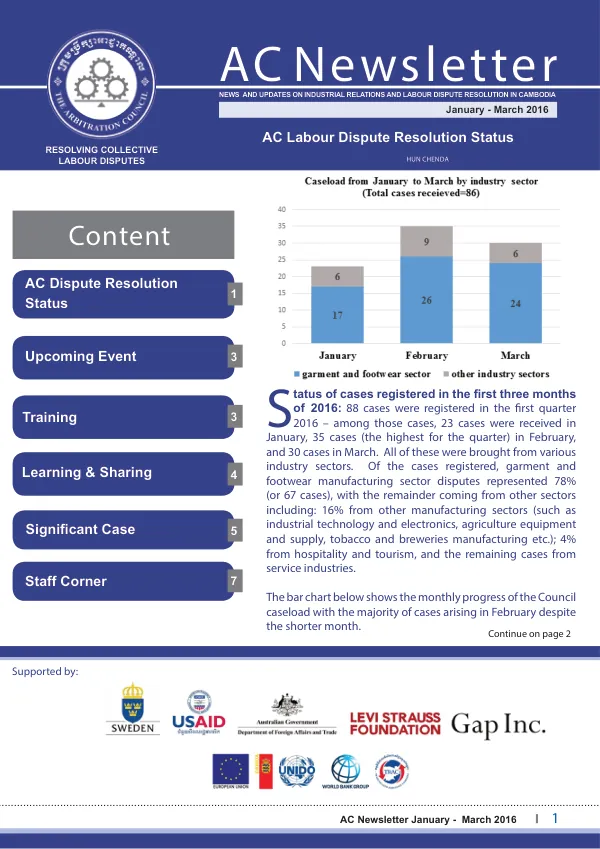
Abstract
As of March 2016, a total of 2,494 collective labour dispute cases have been registered with the AC, representing a significant increase from the initial 4 cases per month in 2003 to 28.7 cases per month in the first quarter of 2016. This increase is a testament to the growing importance of industrial relations in Cambodia, particularly in the garment and footwear manufacturing sector, which accounted for 78% of the cases registered in the first quarter of 2016. The AC has been successful in resolving labour disputes through various means, including issuing arbitral decisions, facilitating agreements between parties, and providing training and education to workers and employer representatives. In the first quarter of 2016, the AC resolved 67% of cases through arbitral decisions, facilitated 29% of parties to reach an agreement, and had 4% of cases pending. The AC's efforts have resulted in a significant increase in household income among program participants, with a 27% increase in household income compared to the control group. The AC has also been actively involved in promoting industrial relations and preventing labour disputes through its training programs. The Arbitration Council Foundation (ACF) has been running a pilot industrial relations training program titled 'Workplace Dispute Prevention and Resolution' since November 2014, with the objective of preventing and resolving labour disputes at the factory level in Cambodia. In the first quarter of 2016, 7 worker and employer representatives participated in the training program, which focuses on better understanding of the employment relationship, identifying and developing workplace cooperation mechanisms, and learning different styles of communication to assist with conflict resolution and negotiation. The ACF will hold the 7th National Industrial Relations Conference (NIRC) on July 5, 2016, which will focus on 'Cambodian Industrial Relations: Maturity and Commitment to Growth'. The conference will provide a platform for key employment and labour stakeholders and partners to engage in constructive social dialogue to improve industrial relations in Cambodia and contribute to broader economic growth and social development. The conference will also provide an opportunity for the tripartite stakeholders and others to directly interact with each other on current matters of common interest. The AC has also been involved in knowledge sharing and exchange with other countries, including Myanmar. In January 2016, the AC accompanied a delegation from the Myanmar Ministry of Labour, Employment, and Social Security to a meeting with the Minister of Labour and Vocational Training in Cambodia. The Minister shared information about the history of Cambodian industry since the 1990s, the draft Law on Trade Unions, Minimum Wage Mechanism, and other industrial relations mechanisms, including the Labour Advisory Group. The Minister also spoke about the importance of the AC in resolving labour disputes, which is a significant challenge as industry grows and the number of federations and local trade unions increase.