USAID DEC
Access to HIV care and treatment for migrants between Lesotho and South Africa: a mixed methods study
Sign inUSAID DEC
Access to HIV care and treatment for migrants between Lesotho and South Africa: a mixed methods study
The HIV treatment and care for migrants between Lesotho and South Africa is affected by their interaction with HIV treatment programs and healthcare systems in different countries.
2018 · 10 pages
Sign in to readA free account is required to download.
Abstract
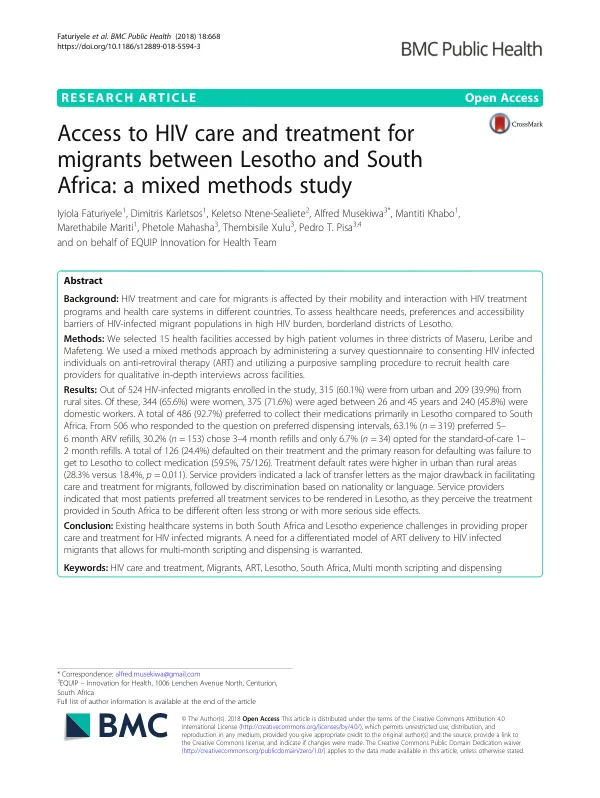
The HIV treatment cascade is impacted by factors such as legal and cultural barriers, discrimination from healthcare providers, and lack of protocols for continuity of HIV care across borders. The Policy Framework for Population Mobility and Communicable Diseases in the Southern African Development Community acknowledges gaps in plans and strategies for controlling HIV/AIDS in the region, including differing treatment protocols and reluctance of healthcare providers in dealing with migrants. The HIV prevalence in Lesotho is estimated to be 25.0% in 2016, with 330,000 people living with HIV. The UNAIDS 90-90-90 targets aim to reduce the burden of HIV/AIDS globally by 2020, with 90% of all people living with HIV knowing their status, 90% of those diagnosed receiving antiretroviral therapy (ART), and 90% of those on ART achieving viral suppression. In Lesotho, 72% of all people living with HIV know their status, and 74% of those diagnosed are on ART. However, innovative interventions are still needed to reach marginalized populations such as migrants. A cross-sectional survey was conducted in 15 health facilities in Lesotho to assess the healthcare needs, preferences, and barriers to HIV care and treatment among HIV-infected migrant populations. The survey included questions on needs, preferences, and experienced barriers to accessing healthcare services, as well as socio-demographic indicators such as occupation, age, and sex. The survey found that 60.1% of the participants were from urban areas, 65.6% were women, and 45.8% were domestic workers. The majority of participants (92.7%) preferred to collect their medications in Lesotho, and 63.1% preferred 5-6 month refills of antiretroviral therapy (ART). The primary reason for defaulting on ART was failure to get to Lesotho to collect medication, which was reported by 59.5% of the participants. The default rates were higher in urban areas (28.3%) compared to rural areas (18.4%). Service providers reported a lack of transfer letters as the major drawback in providing care and treatment for migrants, followed by discrimination based on nationality or language. The study highlights the need for a differentiated model of ART delivery to HIV-infected migrants that allows for multi-month scripting and dispensing. The study's findings are essential for informing the design of targeted interventions to reach marginalized populations such as migrants in Lesotho. The results of this study will help to address the gaps in plans and strategies for controlling HIV/AIDS in the region, including differing treatment protocols and reluctance of healthcare providers in dealing with migrants. The study's recommendations include strengthening cross-border collaborations with neighboring countries and other stakeholders, and providing training to healthcare providers on the care and treatment of migrants.